
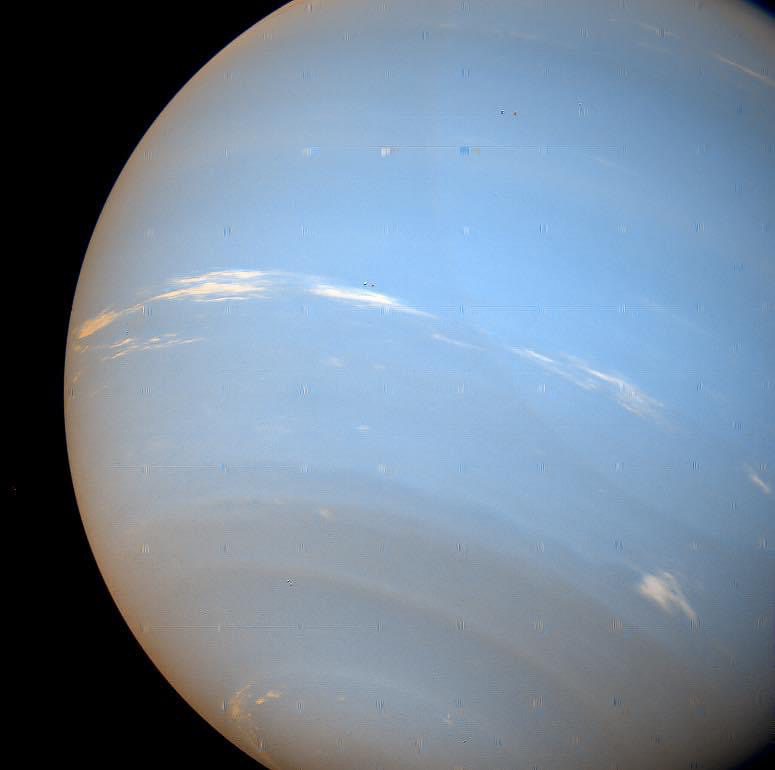
A photograph transmitted by NASA’s Voyager II robotic space probe on August 24, 1989, captures a detailed view of the methane-rich, azure atmosphere of Neptune as the spacecraft prepared for its historic closest approach the following day.
The historic telemetry received on August 24th served as a brilliant display of American aerospace engineering and scientific curiosity operating at the absolute outer edge of the solar system. Launched over a decade prior on a grand tour of the outer planets, the nuclear-powered probe braved extreme radiation fields and immense cosmic distances to provide humanity with its very first high-resolution look at the eighth planet. By capturing the kinetic power of Neptune’s supersonic storm systems, including the famous Great Dark Spot, the imagery completely upended previous scientific assumptions regarding the atmospheric activity of deep-space gas giants.
The transmission marked the final planetary milestone of Voyager’s primary mission, transforming a journey through the dark into a visual ledger of astronomical exploration. The successful mapping of Neptune’s complex ring systems and its icy moon Triton provided scientists with an invaluable boost to planetary research, proving that automated instruments could comfortably navigate billions of miles away from Earth. This transmission expands our definitive baseline of outer solar system science, recording the furthest limits reached by 20th-century planetary exploration.
Image by Kevin Gill from Nashua, NH, United States, CC BY-SA 2.0 via Wikimedia Commons.
