
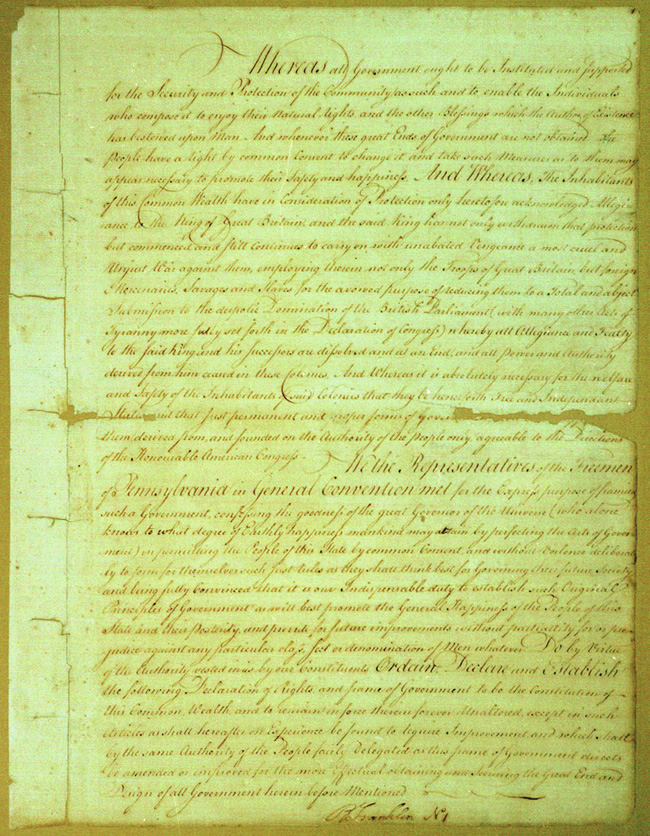
On September 28, 1776, Pennsylvania adopted a new state constitution that became one of the Revolutionary era’s boldest experiments in democratic government. Written in the wake of independence, it rejected key features of British colonial rule, abolishing the office of a single, powerful governor and placing executive authority in a twelve-member Supreme Executive Council. It also established a one-house General Assembly, whose members were chosen in annual elections and limited to four years of service in any seven-year period.
The constitution embraced the language of the “Commonwealth of Pennsylvania,” reflecting the ideal that government should serve the public good. It expanded the electorate beyond property owners by granting voting rights to male freemen aged twenty-one or older who met the constitution’s residence and tax-payment requirements. The new framework also aimed to make lawmaking more accountable: bills of a public nature had to be printed for public consideration before their final legislative reading and ordinarily could not become law until the next legislative session.
Pennsylvania’s 1776 Constitution included an expansive Declaration of Rights. It recognized freedom of conscience in religious worship, protected freedom of speech and the press, and affirmed the people’s right to assemble, instruct their representatives, and petition the legislature for redress of grievances.
Critics, including John Adams, worried that a powerful single-chamber legislature could produce instability and insufficient checks on popular majorities. Yet the constitution was an important laboratory for democratic theory, testing annual elections, broad male suffrage, public lawmaking, and a weakened executive. Pennsylvania replaced it in 1790 with a more conventionally balanced constitution featuring a governor and bicameral legislature, but the 1776 document remains a landmark of the American Revolution’s effort to rethink the structure of political power.
Image via Wikimedia Commons, public domain.
