
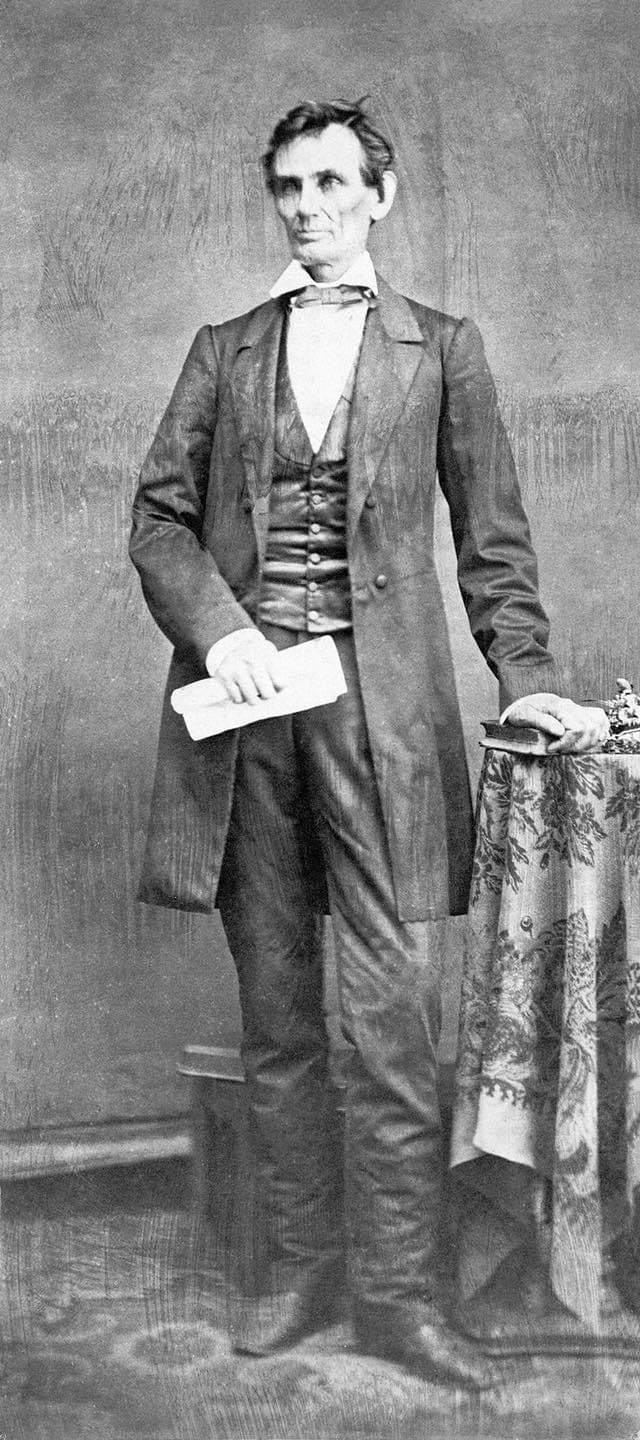
On November 6, 1860, former congressman Abraham Lincoln was elected the sixteenth president of the United States. His victory precipitated a secession crisis that would lead to the American Civil War. Running as the candidate of the young Republican Party, Lincoln won the presidency without carrying a single Southern state—a striking demonstration of the nation’s deepening sectional divide. He secured 180 of the Electoral College’s 303 votes.
Participation was extraordinary. By a commonly cited historical estimate, approximately 81.2 percent of eligible voters cast ballots, making the election second only to 1876 in the reliable turnout record beginning in 1828.
The contest brought four major candidates into the field. The Democratic Party split into rival wings, with Stephen Douglas representing Northern Democrats and John C. Breckinridge representing Southern Democrats, while John Bell ran for the Constitutional Union Party. Lincoln won approximately 39.8 percent of the national popular vote, but his strength in the free states delivered a decisive Electoral College majority.
Lincoln opposed the expansion of slavery into the territories, although he pledged not to interfere with slavery where it already existed. Southern secessionists nevertheless viewed his election as a threat to the institution’s long-term security and their political power. On December 20, just over six weeks after Election Day, South Carolina became the first state to secede. Six more states followed before Lincoln’s inauguration.
The significance of November 6, 1860, lies not in an electorate knowingly choosing civil war, but in the collision between a Republican victory founded on opposition to slavery’s expansion and slaveholding leaders determined to resist that restriction. Lincoln’s election did not make war inevitable, but the secession crisis it precipitated brought the nation to the threshold of armed conflict.
