
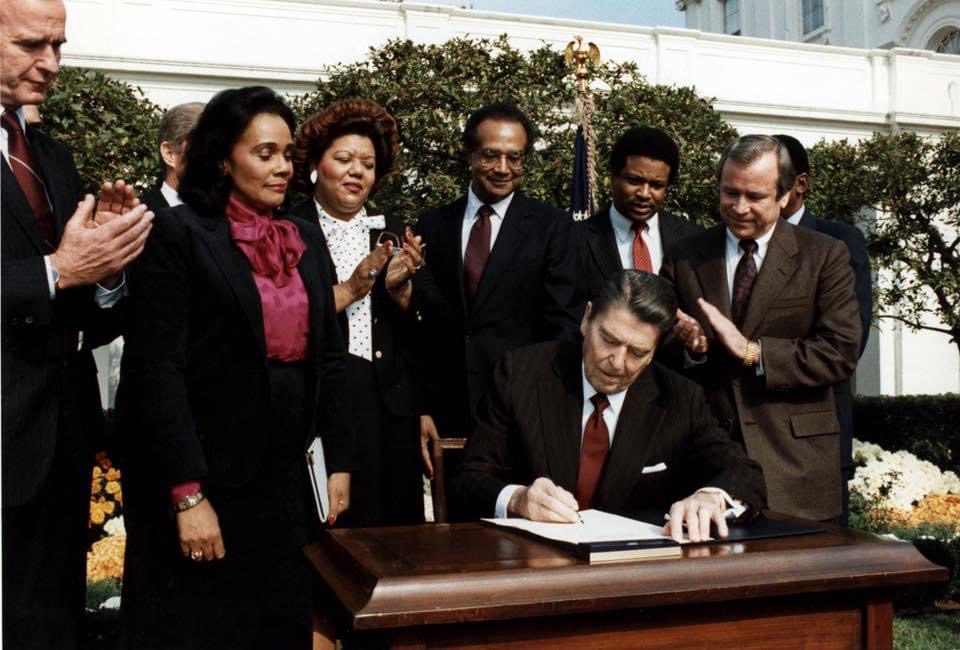
On November 2, 1983, President Ronald Reagan signed legislation in the White House Rose Garden establishing the third Monday in January as a federal holiday honoring Dr. Martin Luther King Jr. The ceremony marked a legislative victory for a campaign that had begun shortly after King’s assassination in 1968. For Coretta Scott King, civil rights activists, labor organizers, and congressional supporters, the signing represented the culmination of fifteen years of organizing to secure a permanent place for King in the nation’s commemorative calendar. The holiday would first be observed in 1986.
The legislation’s passage was neither inevitable nor uncontested. Supporters faced persistent resistance over the cost of an additional federal holiday and the question of whose achievements deserved national recognition. Some opponents also sought to discredit King himself. Senator Jesse Helms of North Carolina attempted to obtain sealed FBI surveillance records as part of his campaign against the bill, invoking allegations of communist influence to challenge King’s suitability for the honor. That effort exposed divisions within the conservative establishment: even as Helms pressed for disclosure, the Reagan administration opposed releasing the records in federal court.
Reagan had previously opposed the holiday, citing concerns that included its economic cost. By the time the legislation reached his desk, however, it had secured overwhelming bipartisan congressional support, passing the House by a veto-proof vote of 338 to 90. His signature therefore marked both a change in presidential policy and the success of a sustained movement that had made recognition of King increasingly difficult to resist.
At the signing ceremony, Reagan presented King’s legacy through the language of reconciliation. He emphasized King’s commitment to nonviolence, the obligations of shared citizenship, and the nation’s capacity for moral change. Yet the speech did not portray racial injustice as entirely overcome. Reagan acknowledged that “traces of bigotry still mar America,” connecting the celebration of King’s achievements to responsibilities that remained unfinished. His remarks framed the holiday as an occasion not simply to remember a leader, but to practice the love of God and neighbor that he associated with King’s work.
The significance of November 2, 1983, rests in that tension between conflict and consensus. A holiday won through years of political struggle entered federal law in a ceremony emphasizing national unity. The signing did not erase the opposition that preceded it or resolve the inequalities King had challenged. It did establish an enduring federal recognition of his life, making remembrance of the civil rights movement part of the nation’s official calendar—and leaving future generations to consider what honoring that legacy should require.
