
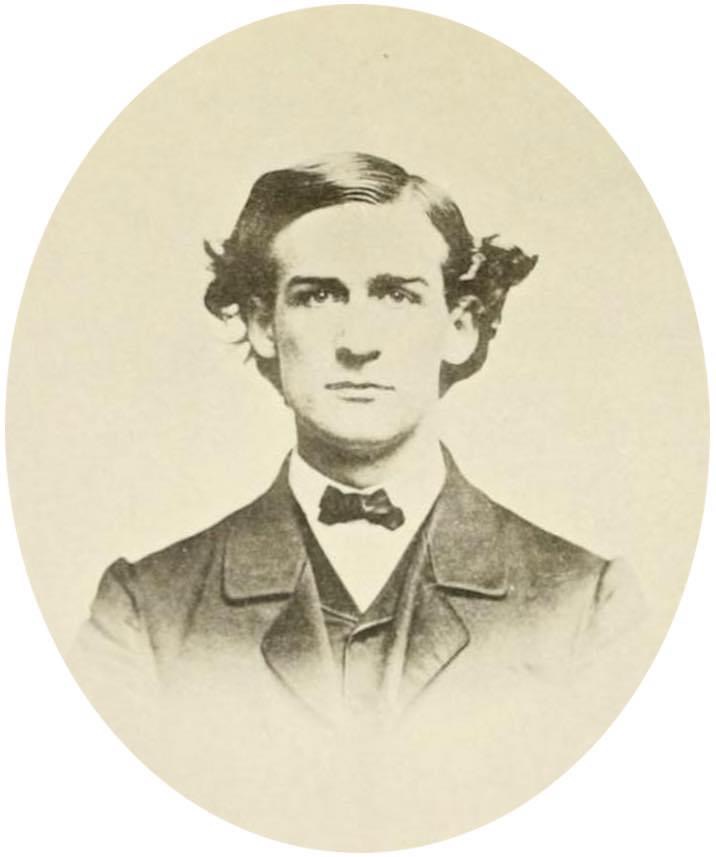
On November 2, 1844, John Jacob Loud was born in Weymouth, Massachusetts. A Harvard graduate trained in law, he later became a bank cashier and an active figure in his community. His most enduring contribution, however, came from an invention intended for a practical task: marking rough surfaces that ordinary pen points could not handle reliably.
On October 30, 1888, three days before his forty-fourth birthday, Loud received U.S. Patent No. 392,046 for what is generally recognized as the first patented ballpoint pen. Instead of a conventional nib, his instrument used a revolving ball at its tip, allowing ink to pass around the sphere onto the surface beneath it. Loud described the device as especially useful for marking wood, coarse wrapping paper, and other rough articles. A spring-loaded mechanism controlled the ball’s movement, while an adjustment regulated ink flow and line width.
Loud’s invention was better suited to marking rough materials than to writing letters. It was not commercially exploited, and the patent eventually lapsed. Half a century later, Hungarian inventor László Bíró patented a more practical ballpoint design in 1938; commercial production followed in Argentina in 1943. Loud’s place in that history rests on an important distinction: he patented the ballpoint principle long before it became a successful everyday writing instrument. His achievement was not the finished modern pen, but an early demonstration of the idea at its heart.
