
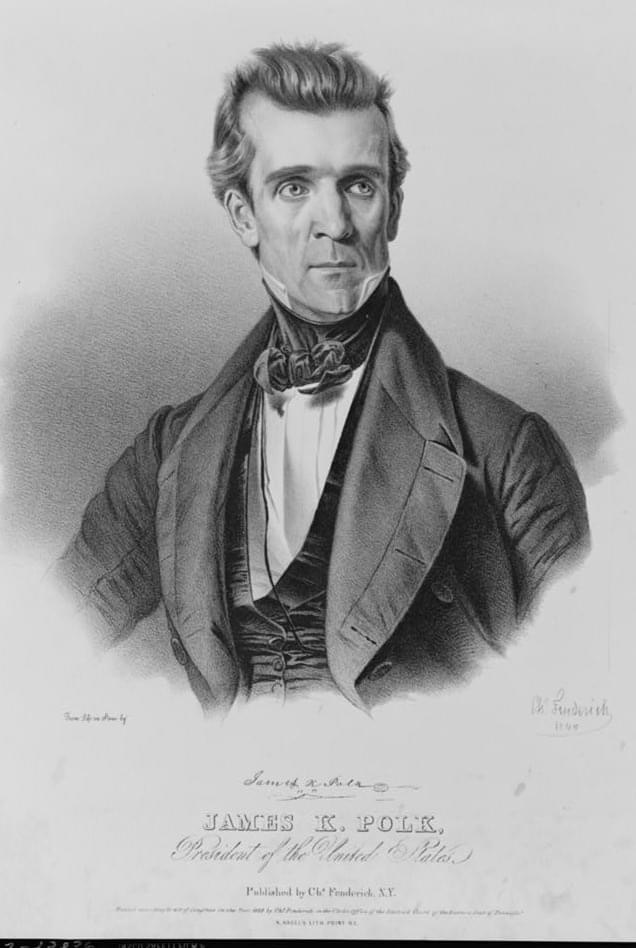
November 2, 1795, marks the birth of James Knox Polk, the future president whose relentless pursuit of expansion would transform the United States. Known as “Young Hickory,” Polk entered the White House in 1845 with four principal objectives: lowering tariffs, restoring an independent treasury, settling the Oregon boundary dispute, and acquiring California. By the end of his single term, he had accomplished those objectives, leaving a record of executive effectiveness matched by profound controversy over the means and consequences of his success.
Polk’s expansionist ambitions brought the relationship between presidential power and constitutional duty into sharp focus. His administration maneuvered the United States into war with Mexico, and although Congress formally authorized the conflict, critics challenged the president’s role in provoking it. Among them was a young Representative Abraham Lincoln, who questioned Polk’s account of the hostilities. In January 1848, Lincoln supported a House amendment declaring that the war had been “unnecessarily and unconstitutionally begun” by the president. The controversy exposed a question that would outlast Polk’s administration: how far could a president use diplomatic and military authority to create circumstances that pushed Congress toward war?
In his Fourth Annual Message to Congress, delivered on December 5, 1848, Polk declared that “the preservation of the Constitution from infraction is the President’s highest duty.” He made that statement while defending the presidential veto, not as a direct justification of the Mexican-American War. Yet the declaration captures a central tension of his presidency: a leader who professed constitutional restraint had exercised executive authority aggressively in pursuit of territorial expansion. In the same message, Polk celebrated the nation’s acquisitions while acknowledging the dangerous sectional dispute over slavery in the new territories.
The enduring significance of Polk’s presidency lies in that collision between territorial achievement and national division. Expansion did not itself determine whether new states would be free or slave, but it made the question of slavery’s western extension impossible to evade. Polk urged compromise, yet his administration had enlarged the republic without resolving the conflict that threatened its unity. His territorial successes intensified the sectional struggle that would culminate in the Civil War, making his presidency both a landmark of American expansion and a consequential chapter in the republic’s movement toward fracture.
Polk survived his presidency by little more than three months. He died of cholera on June 15, 1849, at the age of fifty-three. His legacy remains defined by the distance between accomplishment and consequence: a president who achieved his principal objectives in a single term, but whose successes sharpened a crisis far beyond his power to settle.
