
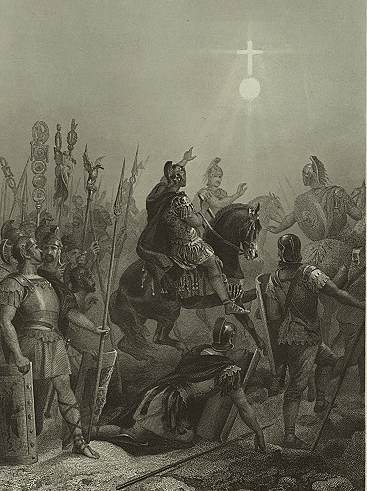
October 27, 312, is traditionally associated with the divine sign Constantine received before the Battle of the Milvian Bridge. The surviving accounts differ. Lactantius describes a dream directing him to mark his soldiers’ shields with a heavenly sign. In a later account, Eusebius describes a cross of light above the sun bearing words commonly translated as “By this sign, conquer,” followed by a dream explaining its meaning. The precise timing of the reported heavenly vision remains uncertain.
On the very next day, October 28th, Constantine defeated his rival Maxentius outside Rome. His victory became a defining episode in the story of his embrace of Christianity and helped usher in a new relationship between the Christian faith and Roman imperial power. But the transformation did not happen overnight. In 313, Constantine and his fellow emperor Licinius agreed to religious toleration and the restoration of confiscated Christian property. Constantine then became an active patron of the Church; Christianity’s establishment as the empire’s official religion came later, under Theodosius I in 380.
The story’s enduring significance lies in the questions it raises about faith and political authority. Centuries later, American debates over religious liberty confronted the consequences of government-supported religion, including persecution and restrictions on dissent. The First Amendment offered a different framework for the national government: Congress could neither establish religion nor prohibit its free exercise. Constantine’s reported vision and America’s constitutional protections belong to very different historical worlds, but they invite reflection on a lasting question: how should religious belief and government power relate to one another?
Rather than trying to banish faith from the public square, the American framework sought to protect it, building the nation upon a profound acknowledgment of Divine Authority. In the Declaration of Independence, the Founders explicitly anchored basic human rights not in the hands of a government or an earthly ruler, but in the Almighty, declaring that all people are “endowed by their Creator with certain unalienable Rights.” They famously closed their founding document with a “firm reliance on the protection of divine Providence,” viewing their quest for liberty as a righteous cause backed by God. By separating the institutional church from the state, they did not diminish God’s authority; instead, they ensured that no earthly president or Congress could ever stand between the citizens and the divine Creator who gave them their freedom.
In many ways, this American approach shared a fundamental objective with Constantine’s historic embrace of Christianity: the desire to anchor human authority in a higher, divine legitimacy. Just as Constantine appealed to a heavenly sign to give his army a sacred purpose and unify a fractured empire, the Founders recognized that a new nation required a justification that transcended human law. Both moments were driven by the conviction that human governance functions at its highest level when it aligns itself with the Almighty, and both sought to rescue faith from the reach of state tyranny. While Constantine used the power of the empire to protect a persecuted Church, the American Founders used the concept of God-given rights to shield individual conscience from government overreach, proving that across centuries and vastly different historical worlds, the ultimate objective remained the defense of liberty under the authority of the Divine.
