
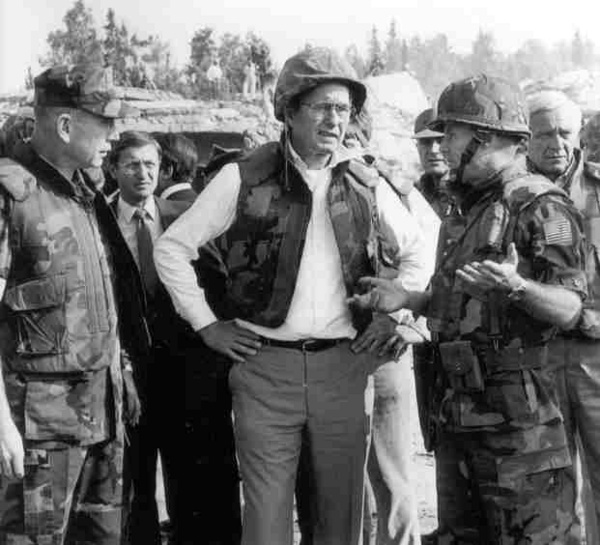
On October 25, 1983, according to the Defense Department’s photograph caption, Vice President George H.W. Bush visited the ruins of the U.S. Marine barracks in Beirut, Lebanon. Two days earlier, a suicide truck bombing had destroyed the building, killing 241 American servicemen serving with the multinational force in Lebanon. At the site, Marine Corps Commandant Gen. P.X. Kelley and Col. Tim Geraghty briefed the vice president amid the wreckage.
The photographs place Bush alongside the commanders responsible for explaining a devastating attack on American forces. Their historical force lies in that encounter: the vice president standing at the destroyed barracks, confronting the human cost of the deployment and the vulnerability of the troops who remained.
The bombing intensified scrutiny of the mission and the security measures intended to protect it. The subsequent military investigation identified failures throughout the chain of command in providing adequate protection against the terrorist threat. Separately, a series of attacks on American installations helped drive a broader reassessment of overseas diplomatic security. The 1985 Inman report recommended stronger security management, hardened facilities, and replacement buildings where existing missions could not be adequately protected.
