
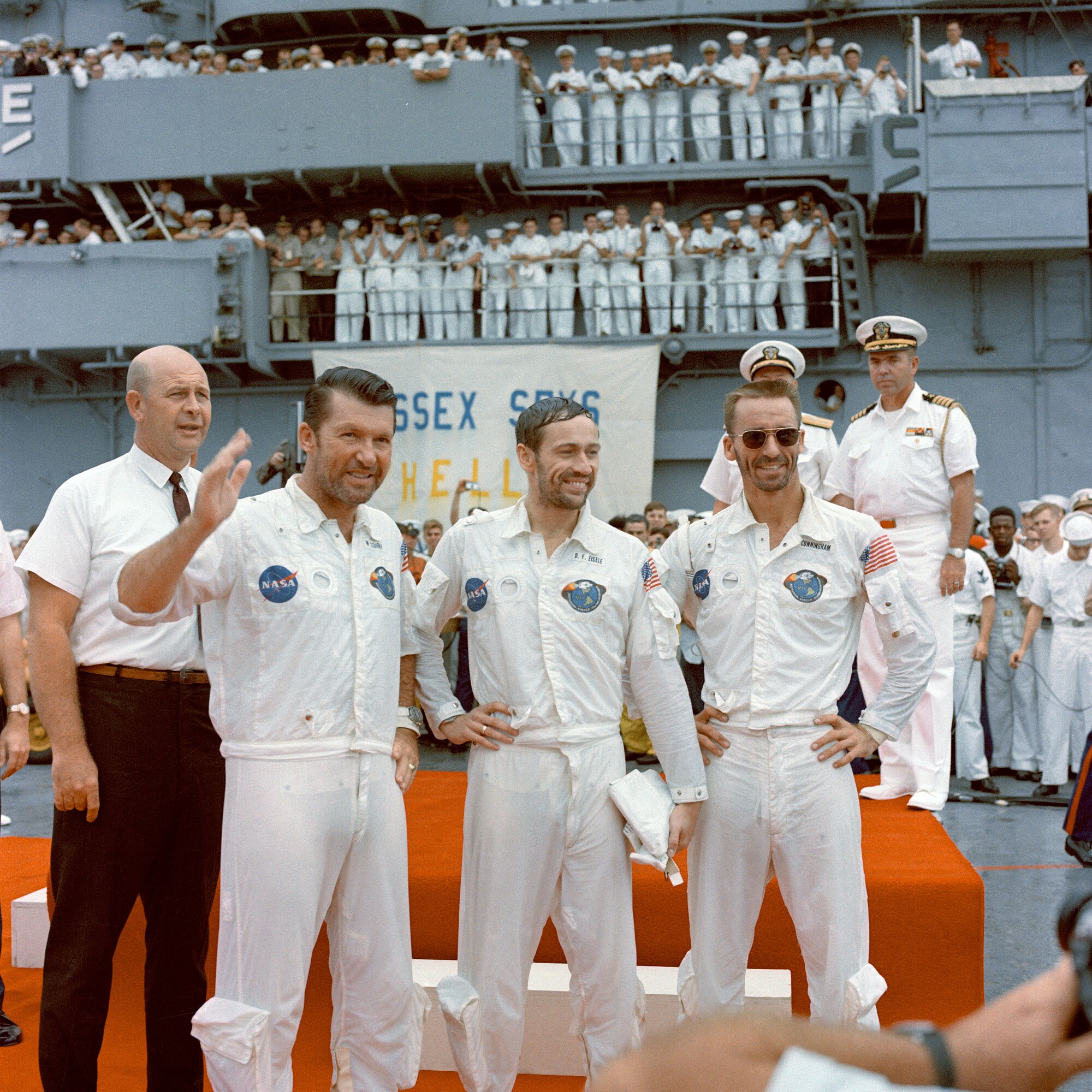
On October 22, 1968, astronauts Walter M. Schirra Jr., Donn F. Eisele, and Walter Cunningham returned to Earth after nearly eleven days aboard Apollo 7, the first crewed mission of the Apollo program. Recovered from the Atlantic Ocean and flown to the aircraft carrier USS Essex, the crew completed a crucial test of the command and service module. Following the Apollo 1 launchpad fire twenty-one months earlier, their successful flight marked an essential step toward sending astronauts to the Moon.
Apollo 7 splashed down at 7:11 a.m. EDT in the Atlantic south of Bermuda. The command module initially floated upside down before inflatable uprighting bags restored it to a nose-up position. Navy rescue swimmers then secured a flotation collar around the spacecraft. The astronauts emerged one by one, were hoisted aboard a recovery helicopter, and were flown to the Essex, where the ship’s captain and hundreds of cheering sailors welcomed them.
Despite severe head colds, the crew completed 163 Earth orbits and carried out a highly successful engineering test of the spacecraft. Over 260 hours of flight, Apollo 7 demonstrated the capabilities of the command and service module, including its service propulsion engine, which fired eight times during the mission. Those results helped clear the way for Apollo 8’s journey into lunar orbit, bringing the goal of a crewed Moon landing closer to reality.
Image: Astronauts Walter M. Schirra Jr., Donn F. Eisele, and Walter Cunningham are welcomed aboard the aircraft carrier USS Essex on October 22, 1968, following their recovery from the Atlantic Ocean. Their return concluded Apollo 7, the first crewed mission of the Apollo program, after nearly eleven days in Earth orbit.
