
On October 21, 1944, American forces captured Aachen, making it the first major German city to fall to the Allies during World War II. The U.S. Army’s 1st Infantry Division, whose 26th Infantry Regiment led the assault inside the city, fought alongside other American formations, including the 30th Infantry Division, which helped complete the encirclement. The historic city associated with Charlemagne had become a symbolic test of Nazi Germany’s determination to defend its own territory.
The October 2–21 operation lasted nearly three weeks. American troops entered Aachen’s northeastern factory district on October 12, with the main assault into the city developing the following day. Infantry advanced through residential blocks, factories, and fortified buildings, supported by tanks, engineers, and artillery. German defenders resisted from cellars, strongpoints, and underground passages as American forces used concentrated firepower to overcome them. The fighting compounded the destruction already inflicted by Allied bombing.
The battle ended on October 21, when Colonel Gerhard Wilck, commander of Aachen’s garrison, surrendered the remaining defenders. Although most residents had left before the fighting inside the city began, thousands of civilians remained, many sheltering in cellars and air-raid bunkers. American troops evacuated approximately 3,700 civilians to a former German military barracks at nearby Brand.
Aachen’s capture dealt a symbolic blow to the Nazi regime and demonstrated the demands of fighting on German soil. Its military legacy lies in the methods used to take it: encirclement, building-by-building assaults, close coordination between infantry and supporting weapons, and the evacuation of civilians amid combat. The battle remains a case study in the complexity and destructive consequences of urban warfare.
Photo Caption:
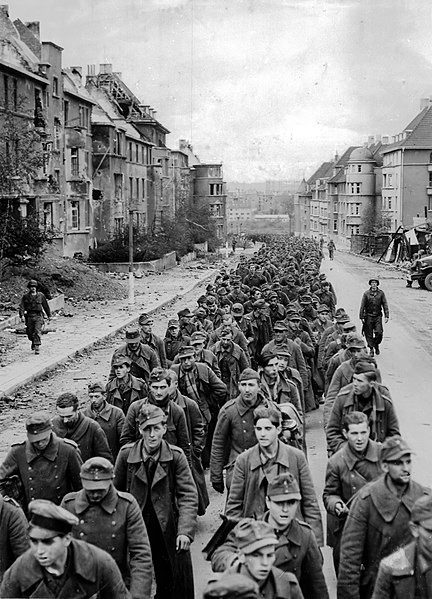
German Prisoners Under American Guard in Aachen
German prisoners march through Aachen under American guard in October 1944. The city surrendered on October 21 after bitter house-to-house fighting, becoming the first major German city captured by the Allies during World War II. Photograph courtesy of the National Archives and Records Administration.
