
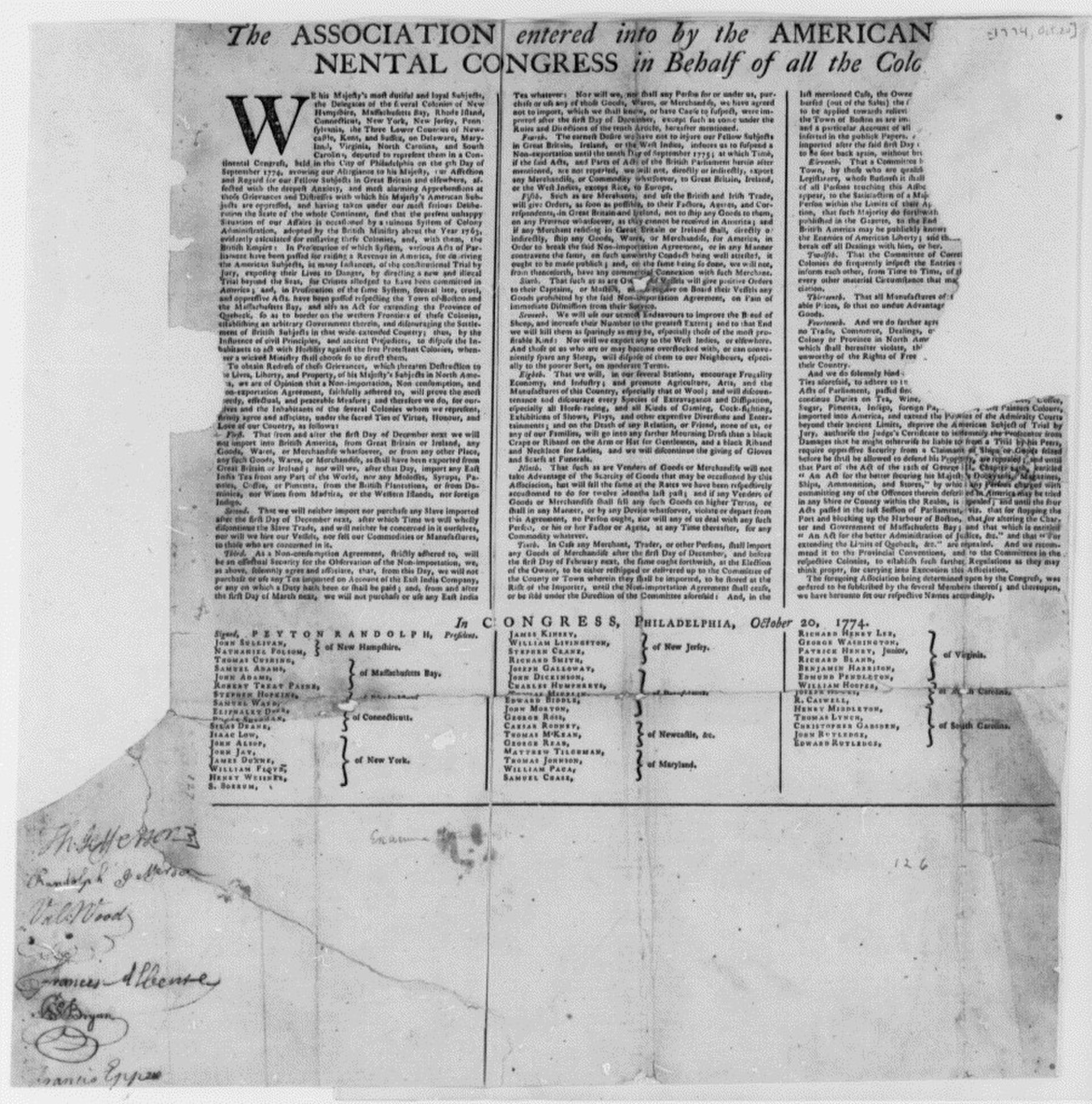
On October 20, 1774, the First Continental Congress adopted the Continental Association, turning constitutional grievances into a coordinated program of economic resistance. Meeting at Carpenters’ Hall in Philadelphia, delegates from twelve colonies agreed to restrictions on imports, consumption, and exports intended to pressure Britain into repealing the legislation they opposed. The Association gave practical force to the Congress’s demands while presenting economic pressure as a peaceable means of obtaining redress.
The boycott proceeded in stages. Imports from Great Britain and Ireland were to cease on December 1, 1774, alongside restrictions on specified goods from other regions. An export boycott targeting Great Britain, Ireland, and the West Indies would begin on September 10, 1775, unless the disputed legislation was repealed, with an exception for rice exported to Europe. The agreement also pledged to end slave importation and participation in the slave trade after December 1, though it neither abolished slavery nor established that compliance would be universal.
To enforce the agreement, Congress called for committees in every county, city, and town, chosen by those eligible to vote for colonial legislative representatives. These committees were to investigate violations, publish offenders’ names, and mobilize economic boycotts against them. Enforcement depended on local organization and community pressure, bringing thousands of colonists into the practical work of resistance.
The Continental Association did more than organize a boycott. It linked local action to a shared intercolonial program and helped develop institutions that would support the revolutionary movement. Its committees did not yet form a unified national government, and some built on earlier networks of correspondence. Nevertheless, they made resistance an everyday practice in shops, ports, households, and town meetings—extending political participation well beyond the delegates assembled in Philadelphia.
