
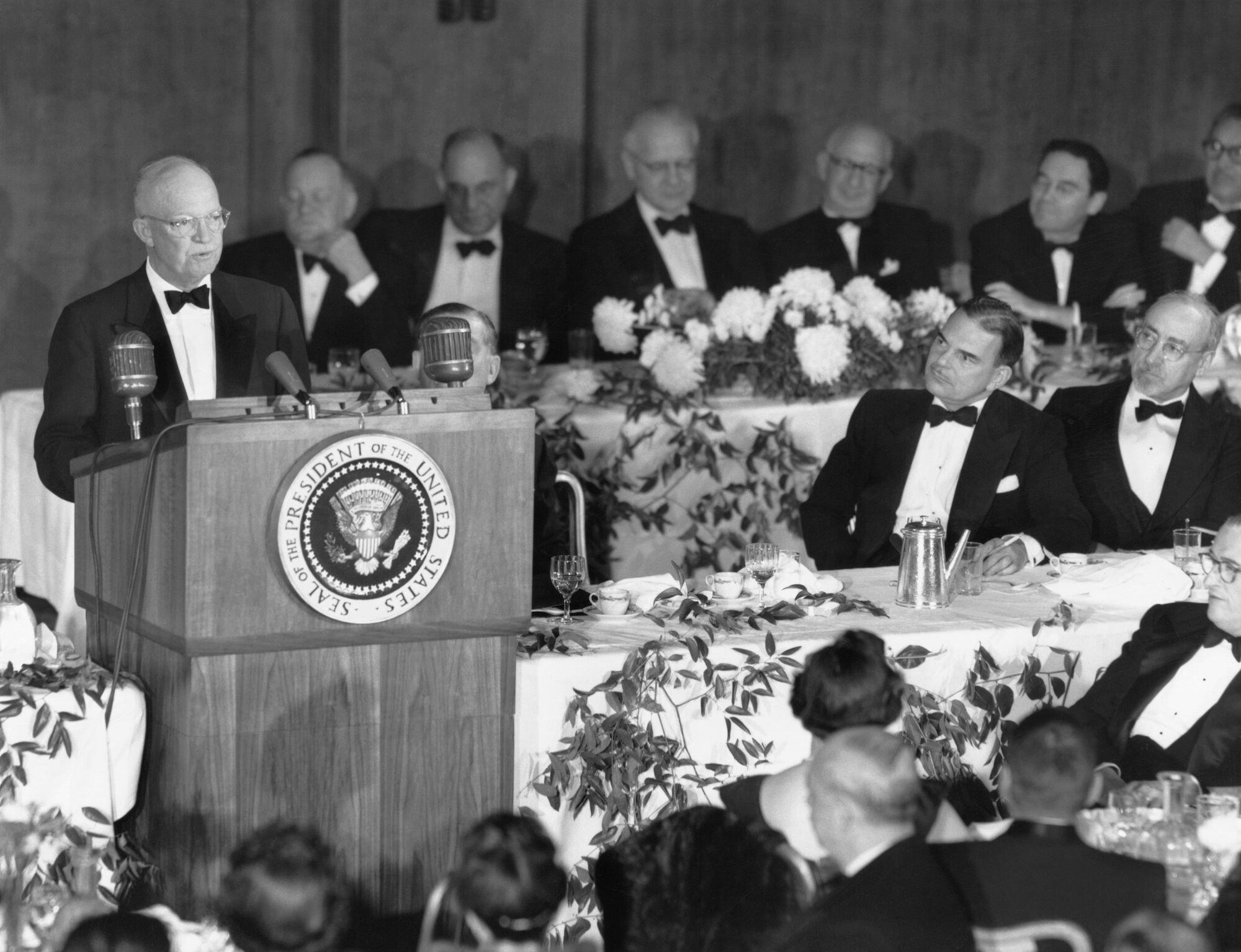
On October 20, 1954, President Dwight D. Eisenhower addressed the American Jewish Tercentenary Dinner at New York City’s Sheraton-Astor Hotel. Commemorating the arrival of twenty-three Jewish settlers in New Amsterdam three centuries earlier, he described their history as meaningful not only to Jewish Americans but to Americans “of all faiths, of all national origins.” He used the anniversary to connect religious freedom and human dignity with the United States’ responsibilities in a divided world.
Eisenhower opened by crediting Jewish religious tradition with helping shape Western ideals of freedom, justice, and the worth of the individual. He contrasted those ideals with the persecution inflicted by Nazism and fascism and with what he called the “atheistic ruthlessness” of contemporary communism. Invoking “our common Judeo-Christian civilization,” he presented the pursuit of peace as both a religious obligation and a national policy.
The address then turned to a substantial account of American foreign policy. Eisenhower outlined three paths toward peace: persistent negotiation, stronger cooperation among free nations, and sufficient military power to deter aggression. “We must promote the unity and collective strength of other free peoples,” he declared, placing alliances and international cooperation at the center of that strategy. He also discussed nuclear technology, economic development, and unresolved tensions between Israel and the Arab states.
The speech thus joined a commemoration of Jewish settlement to a broader defense of Eisenhower’s Cold War policies. Returning in his closing remarks to the settlers’ pursuit of dignity and freedom, he argued that peace meant more than the absence of war: it required conditions in which people could live honorably and securely. The anniversary became an occasion to connect the experience of a historic community with what he described as a shared responsibility to work for peace.
