
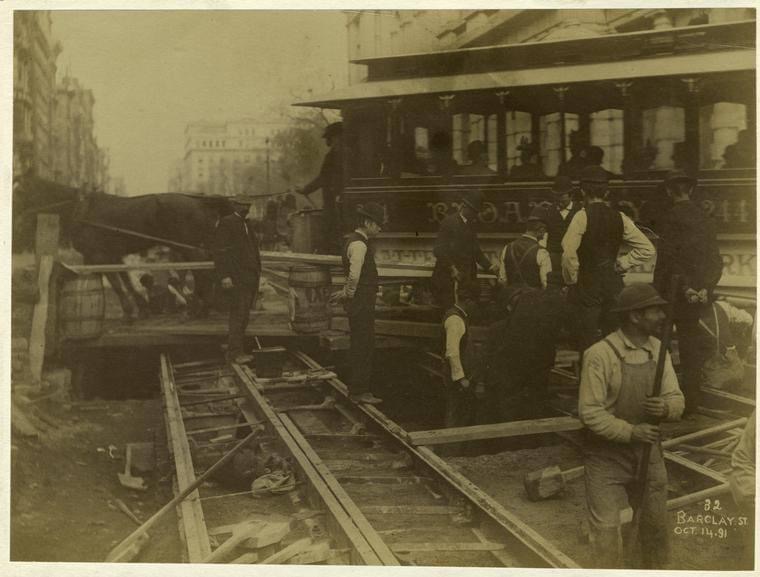
On October 14, 1891, workers labored in an open trench on Barclay Street as a horse-drawn trolley crowded with passengers passed nearby. The photograph captures a familiar tension in late-Gilded Age New York: the city’s rapid commercial growth demanded constant street and utility work, even as traffic, commerce, and transit had to keep moving.
In the early 1890s, Manhattan’s streets were being remade around competing forms of mobility. Horse-drawn cars remained central to short-distance travel, while cable roads, early electric lines, and expanding networks of water, gas, and electrical infrastructure required repeated excavation of the city’s crowded roadways. Much of this work was performed by hand by large crews, often immigrant laborers, working amid heavy traffic and hazardous conditions.
The scene offers a valuable window into the social and engineering history of New York. It shows a city modernizing in public, beneath and around the daily movement of people and goods—an ongoing process that helped shape the more integrated transit networks and, eventually, the subway system of the twentieth-century metropolis.
