
On October 11, 1890, the National Society Daughters of the American Revolution was formally organized at the Strathmore Arms in Washington, D.C. Eighteen women gathered for the founding meeting, inspired by four women—Mary Desha, Mary Smith Lockwood, Ellen Hardin Walworth, and Eugenia Washington—who had helped lead the effort after the Sons of the American Revolution voted earlier that year to exclude women from membership. Their response was to establish a separate national lineage society devoted to historic preservation, patriotic education, and honoring the Revolutionary-era ancestors whose service helped shape the United States.
Among the DAR’s four recognized founders was Eugenia Washington, a great-grandniece of George Washington. Known as “Miss Eugie,” she brought both a personal connection to the Revolutionary generation and practical administrative skill to the young organization. As the DAR’s first Registrar, she helped establish the careful documentation of ancestry that became central to membership, ensuring that claims of descent from Revolutionary-era patriots were supported by verifiable records.
The society’s first President General was First Lady Caroline Scott Harrison, wife of President Benjamin Harrison. Her leadership gave the new organization early national visibility and helped position it as a significant force in American civic life. Under subsequent generations of members, the DAR expanded from its modest founding into an extensive network of local chapters, while developing a headquarters complex in Washington, D.C. that includes major facilities for genealogical research, archives, and historic preservation.
The founding of the DAR institutionalized a durable form of Revolutionary memory: one grounded in family history, documented lineage, and public service. It also created a lasting platform for women to lead preservation, education, and patriotic civic work at a time when such national leadership roles remained largely closed to them.
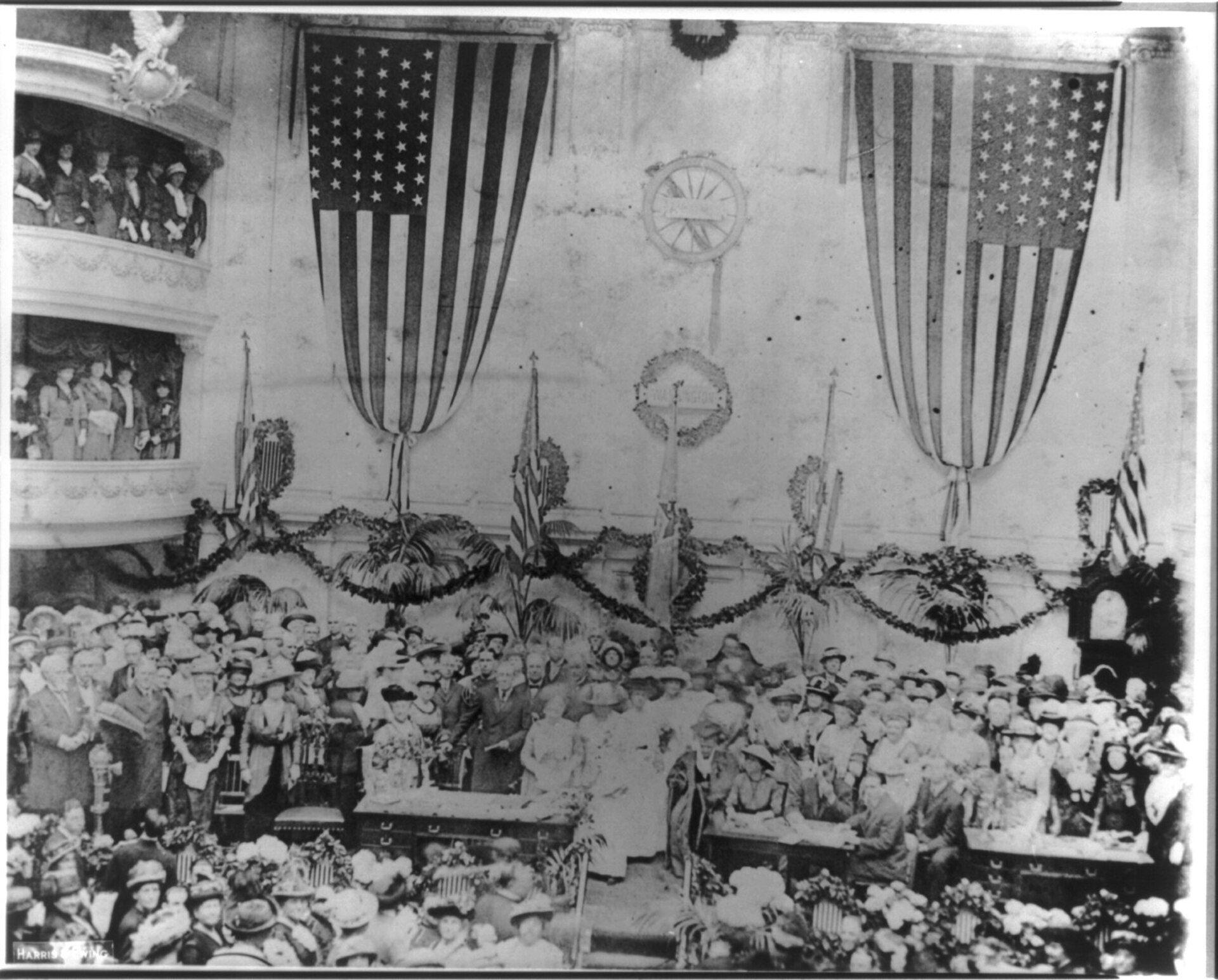
Image: Opening session of DAR convention in 1913
