
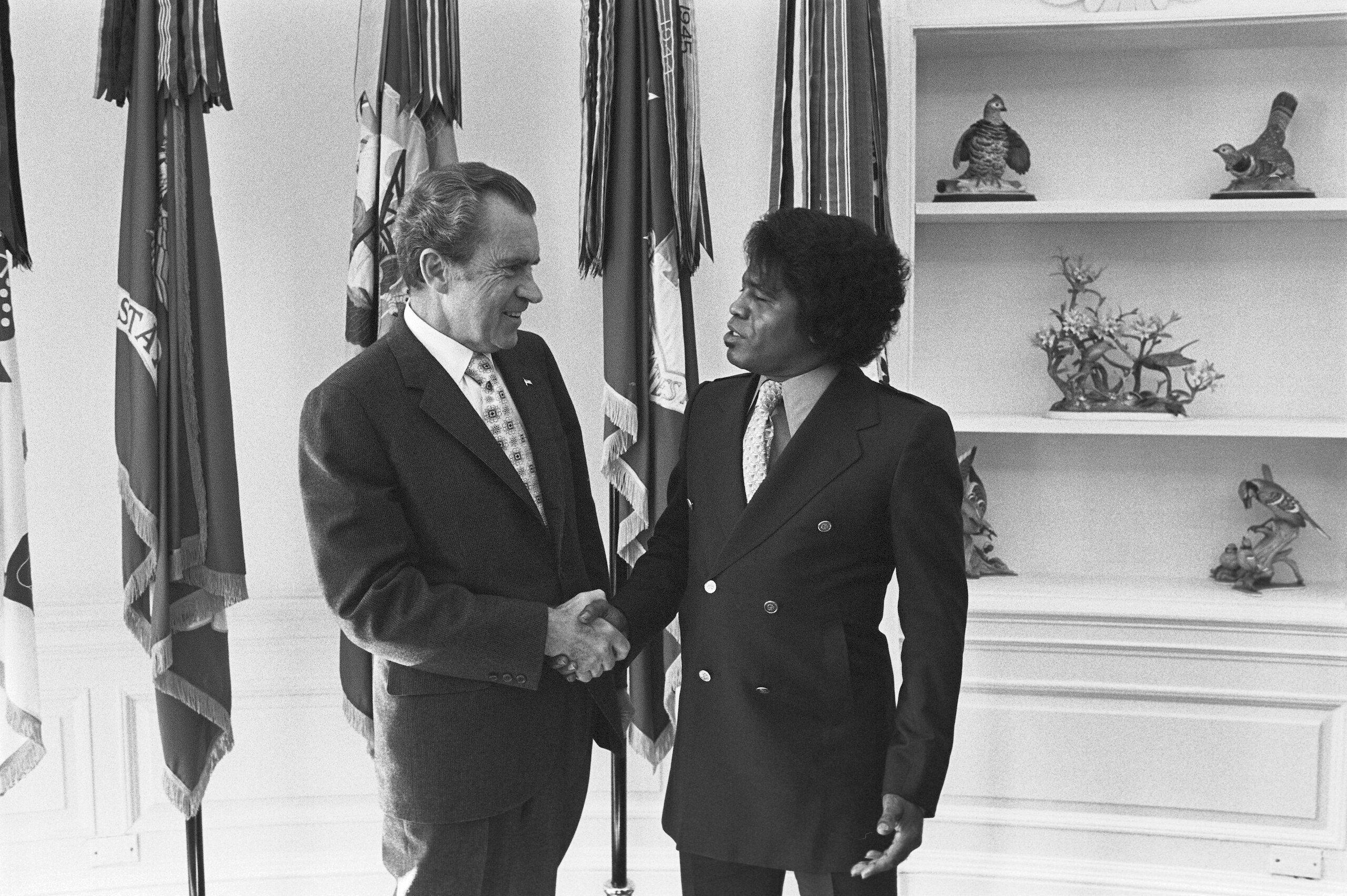
On October 10, 1972, President Richard Nixon met with legendary soul musician James Brown in the Oval Office, an unusual convergence of presidential politics and American popular culture. The brief meeting—held from 12:17 to 12:27 p.m. and attended by several Brown associates, White House officials, and a White House photographer—came during the final weeks of Nixon’s reelection campaign. Brown, already a major cultural figure and entrepreneur, brought to the White House a long-standing interest in Black economic self-reliance, business ownership, and community advancement.
The encounter became closely associated with Brown’s public support for Nixon’s reelection, a decision that surprised and angered many observers, particularly within parts of the civil-rights and Black political establishment. Brown did not present himself primarily as a conventional Republican partisan. Rather, he was attracted to the prospect that federal policy might expand opportunities for Black-owned businesses and viewed economic independence as an essential component of racial progress. His position aligned, at least in part, with Nixon-era appeals to “Black capitalism,” even as many activists regarded those appeals with deep skepticism.
Brown also used his access to raise issues affecting Black Americans. Accounts of the meeting note his interest in establishing a national holiday to honor Martin Luther King Jr., an idea Nixon did not embrace at the time. The exchange therefore reflected both the limits and the ambitions of celebrity political access: Brown sought a direct audience with the president, while the Nixon administration gained a valuable public association with one of the country’s most influential Black entertainers.
The photograph of Nixon and Brown shaking hands has become a notable image of the political tensions and realignments of the early 1970s. To critics, Brown’s support for Nixon appeared to be a calculated public-relations gain for an administration seeking greater Black support. To Brown, however, engagement with the White House offered a practical—if controversial—way to pursue his economic vision. The encounter remains a revealing episode in the social history of the presidency, illustrating the complicated relationship among celebrity, political outreach, Black entrepreneurship, and electoral strategy during a period of profound national change.
