
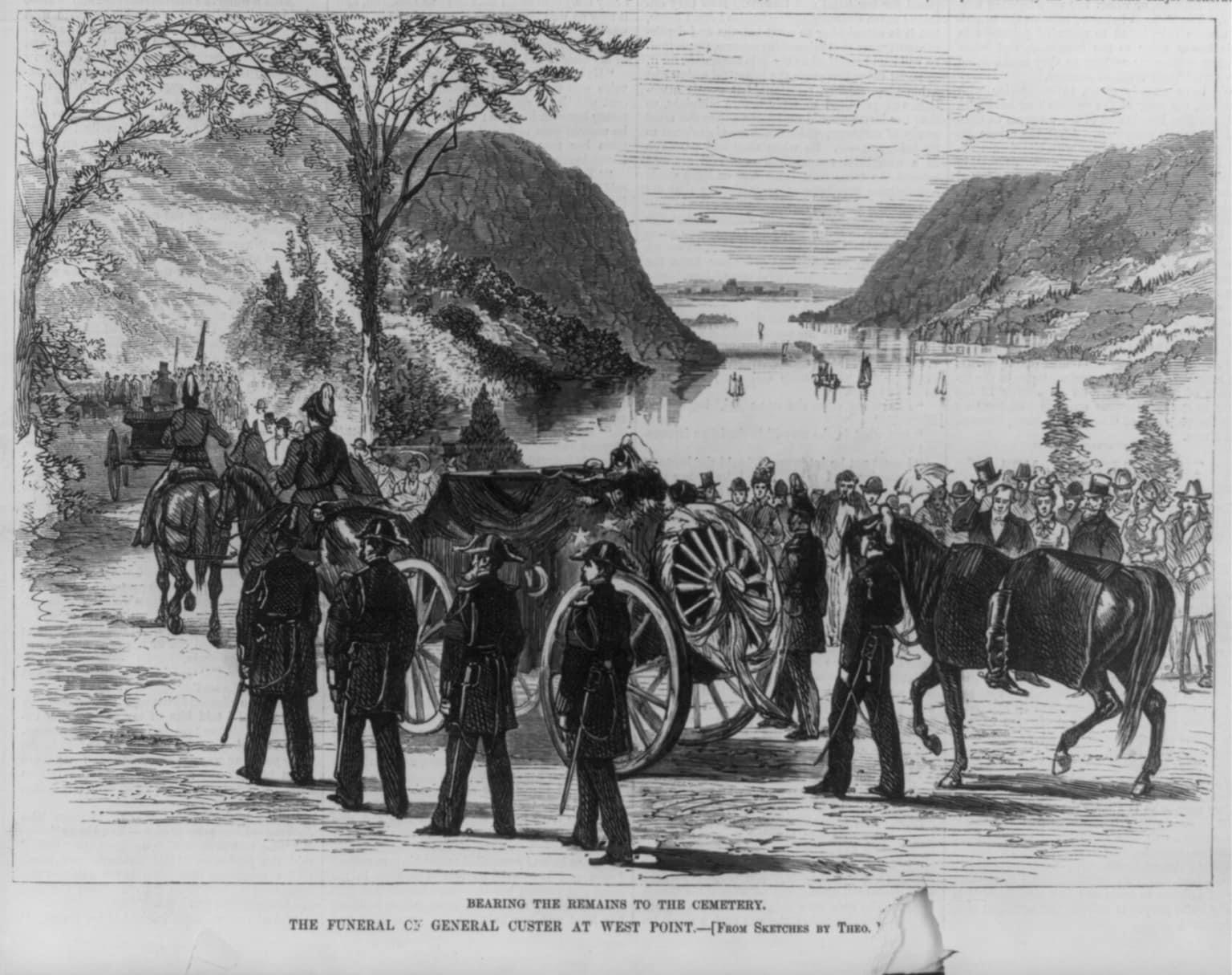
On October 10, 1877, a solemn military procession moved through the grounds of the United States Military Academy at West Point, New York, for the formal reburial of Lieutenant Colonel George Armstrong Custer. Custer had been killed more than a year earlier, on June 25, 1876, along with more than 200 men of the 7th U.S. Cavalry, during the defeat of his command at the Battle of the Little Bighorn in Montana Territory. Initially buried in a shallow battlefield grave, his remains were later exhumed and transported east. Before the West Point ceremony, the coffin was held temporarily in Poughkeepsie and then conveyed by steamer up the Hudson River for permanent interment at the academy cemetery.
The funeral was conducted with full military honors and drew prominent military figures, veterans, and a large public gathering. Services were held in the chapel before the procession moved to the cemetery, accompanied by a funeral march; the burial concluded with the reading of the service and a three-round infantry salute. The event became part of the broader public effort to commemorate one of the most famous—and controversial—officers in American military history.
Custer’s reburial also helped shape the memory of the Little Bighorn. In the years that followed, newspaper coverage, veteran reminiscences, and the work of his widow, Elizabeth “Libbie” Custer, contributed to a powerful popular image of Custer’s death as a heroic last stand. That image often overshadowed questions about the battle’s tactical failures, the U.S. Army’s campaign against the Lakota and Cheyenne, and the wider violence of the Indian Wars.
The ceremony’s records, contemporary press accounts, and visual depictions offer a revealing window into Gilded Age mourning culture and military pageantry. By placing Custer’s grave at the cemetery of his alma mater, the Army gave his memory a permanent institutional setting. He was buried near the Old Cadet Chapel, and a large granite monument now marks the site. The grave remains a reminder that public ritual does more than honor the dead: it can also shape how a nation understands military catastrophe, heroism, conquest, and memory.
