
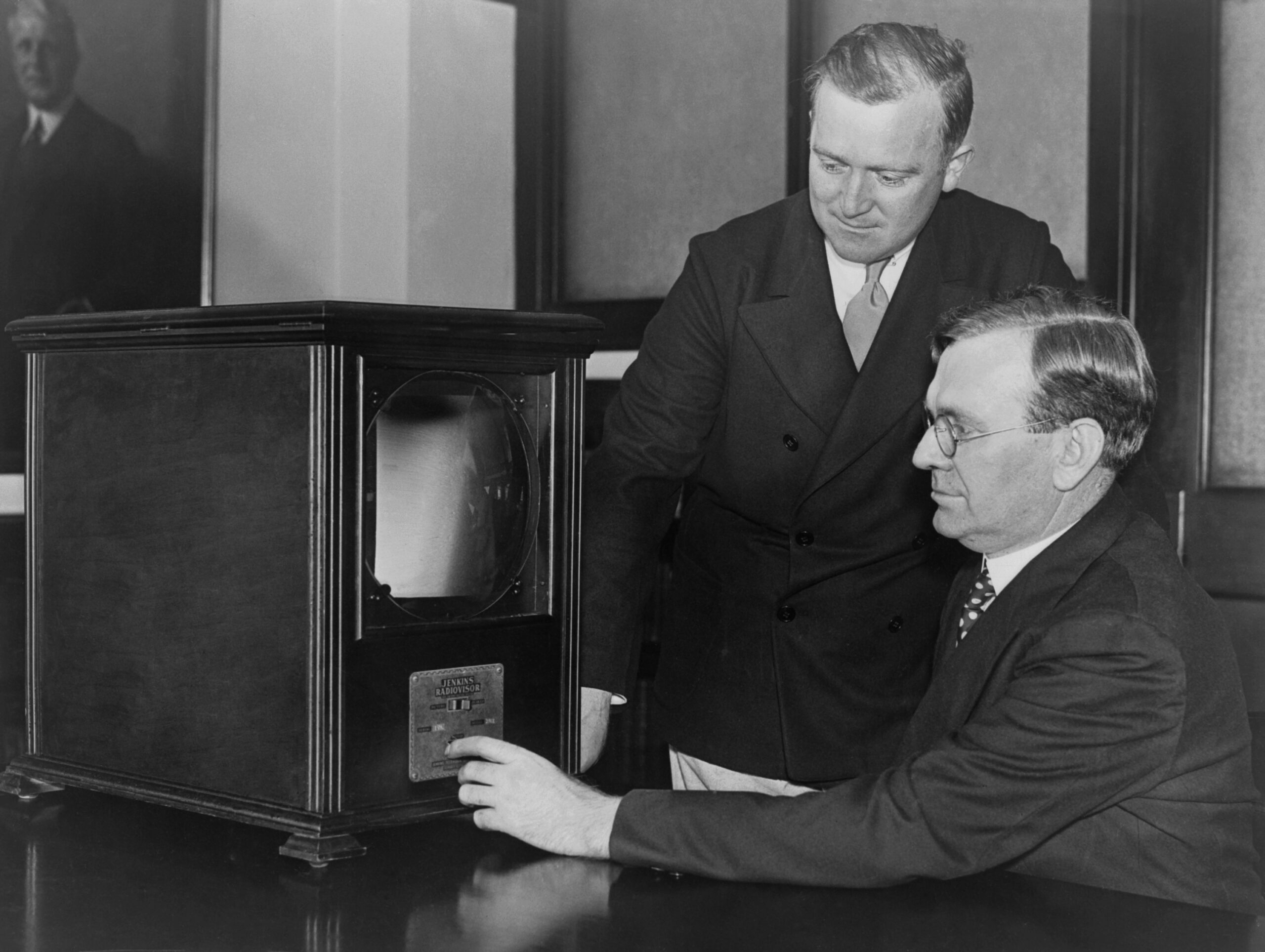
One of the first regularly scheduled television programs, Piano Lessons, began airing in New York City on October 8, 1931. The experimental broadcast was an early attempt to use television’s visual possibilities for education and instruction.
At the time, roughly 1,000 U.S. households had television sets. The technology remained in its infancy: stations broadcast only limited schedules, and their signals reached a small, exclusive group of early adopters.
Labor Secretary William Doak and W. W. King examine a television receiver at the Department of Labor in 1931. Its magnifying screen helped viewers see the small, round image typical of the era’s primitive sets.
