
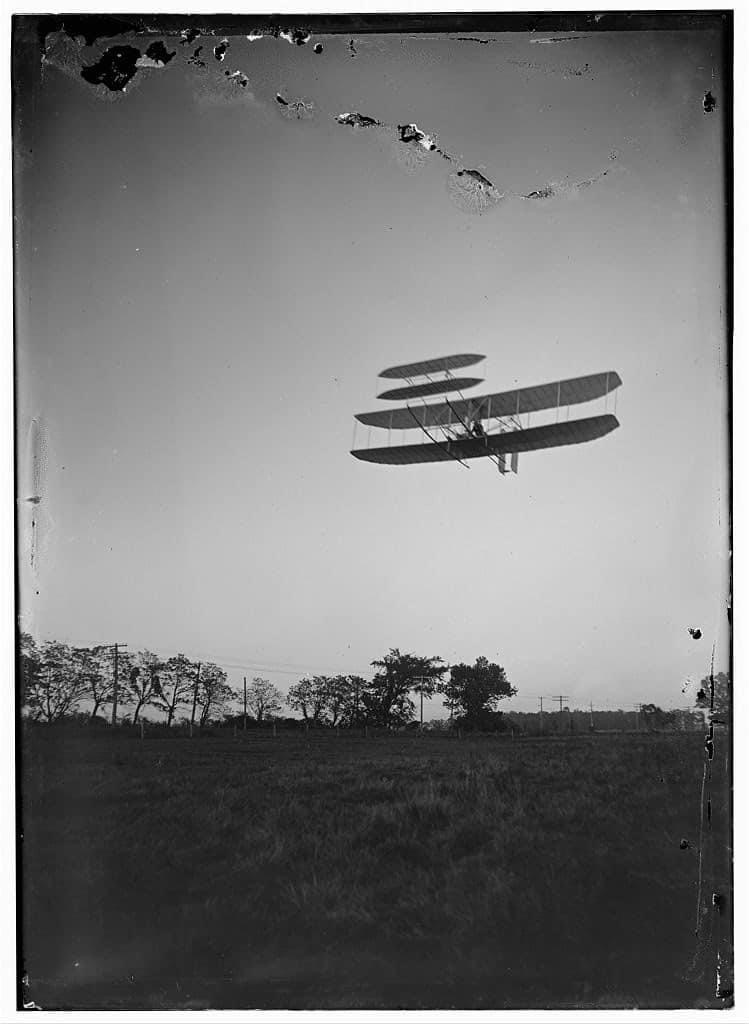
On October 5, 1905, Wilbur Wright achieved a defining milestone in aviation history at Huffman Prairie near Dayton, Ohio. Flying the Wright Flyer III, he remained airborne for about 39 minutes, circling the field roughly 30 times and covering just over 24 miles before landing when the fuel ran out. The achievement showed that controlled, sustained powered flight was no longer a distant ambition, but a practical reality.
The Flyer III differed substantially from the Wrights’ earlier experimental machines. After a redesign that improved its stability and handling, the aircraft could bank, turn in circles, and fly figure-eights under the pilot’s control. These advances transformed flight from a series of short, precarious trials into something repeatable, navigable, and dependable.
The October flight established the Flyer III as the world’s first practical airplane: a machine capable of taking off under its own power, remaining aloft for an extended period, maneuvering deliberately, and landing safely. Having demonstrated that capability, the Wright brothers turned their attention toward protecting their invention and finding military and commercial buyers rather than continuing public test flights.
