
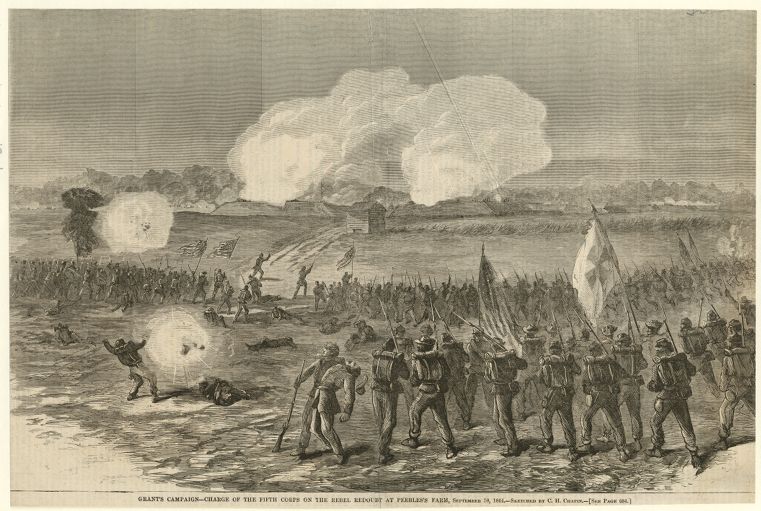
On September 30, 1864, Major General Gouverneur K. Warren’s Union Fifth Corps joined a major Federal offensive southwest of Petersburg, Virginia. Moving in concert with elements of the Ninth Corps and David McM. Gregg’s cavalry, Warren’s soldiers helped overrun a lightly held outer Confederate line near Poplar Spring Church and Squirrel Level Road. The operation formed part of Lieutenant General Ulysses S. Grant’s autumn effort to extend the Union left, threaten the Boydton Plank Road and South Side Railroad, and tighten the siege of Robert E. Lee’s army at Petersburg.
The initial success did not produce all that Grant had hoped. Confederate reinforcements checked the advance before the Federals could seize the Boydton Plank Road or South Side Railroad. Still, the Union retained ground west of its earlier positions, gained important secondary roads, and extended its siege lines farther west—another increment in the steadily tightening pressure on Petersburg.
That tactical gain stands in striking contrast to the personal trajectory of Warren, one of the Army of the Potomac’s ablest engineers and commanders. Celebrated for recognizing the exposed Union left at Little Round Top during Gettysburg and helping place troops there in time, Warren would see his reputation shattered only months before the war’s end. On April 1, 1865, at Five Forks, Major General Philip Sheridan relieved him of command of the Fifth Corps for alleged “unskillful” conduct, arguing that Warren had not moved and pressed his troops with sufficient speed.
Warren resigned his volunteer major-general commission in protest after the war, reverting to his Regular Army rank in the Corps of Engineers. He then spent years seeking an official inquiry into his removal. In 1879, he finally received one. The board’s findings, published in November 1882, largely cleared him and specifically exonerated him of neglect at Five Forks—but Warren had died three months earlier, on August 8, 1882. His vindication arrived too late for the officer who had spent the final years of his life trying to reclaim his name.
Image credit: C. E. Chapin, “Charge of the Fifth Corps,” New York Public Library Digital Collections; no known restrictions.
