
American football entered a new era on September 28, 1892, when Mansfield State Normal School faced Wyoming Seminary in what is widely recognized as the first American football game played at night. The exhibition took place at Smythe Park in Mansfield, Pennsylvania, during the annual Great Mansfield Fair.
The game was both a sporting event and a demonstration of new electric-lighting technology. A Thomson-Houston dynamo—associated with the recently formed General Electric Company—powered 20 powerful arc lamps and five smaller incandescent lamps. Yet the experimental setup was poorly suited to football. Much of the light came from the grandstand and a pole positioned in the middle of the field, while the rest of the playing surface remained dim and unevenly lit.
The teams began at 6:45 p.m., while some twilight remained, despite a scheduled 7:30 start. Wyoming Seminary wore white uniforms to improve visibility. Even so, players struggled to see the ball and one another; later accounts describe tackles being made on anyone in a uniform. After only about 20 minutes and 10 plays, the teams ended the contest at halftime in a scoreless 0–0 draw because continuing was considered impractical and unsafe.
By modern standards, the experiment was a failure. But its ambition mattered: the confused, faintly lit game at Mansfield became an early landmark in the development of night athletics, anticipating the illuminated stadiums that would eventually make football a major prime-time spectacle.
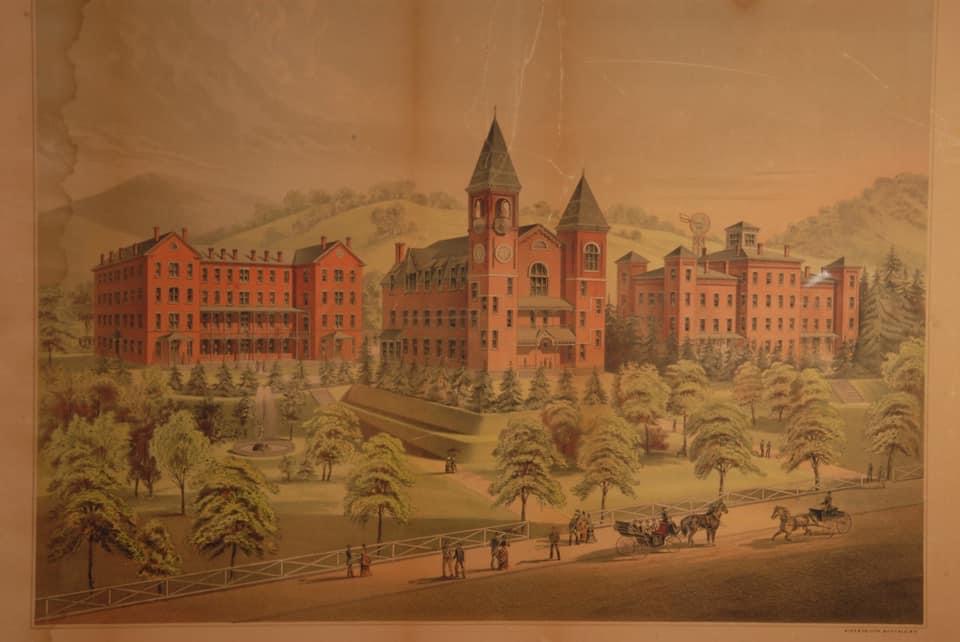
Image: A lithograph of Mansfield State Normal School in the 1880s, via Wikimedia Commons, public domain.
