
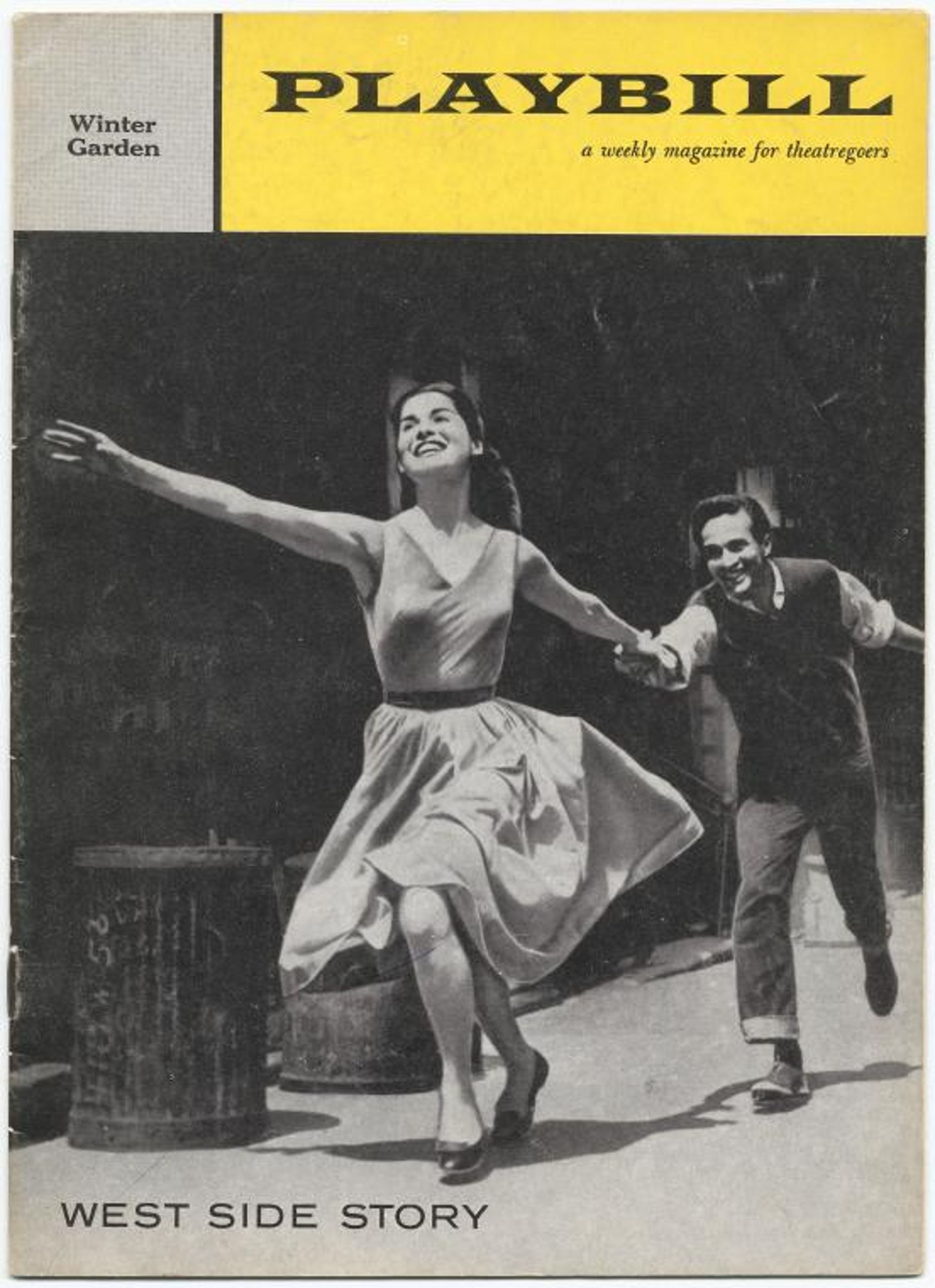
On September 26, 1957, West Side Story opened on Broadway at the Winter Garden Theatre, becoming one of the defining works in the evolution of the American musical. A bold reimagining of William Shakespeare’s Romeo and Juliet, it placed a tragic love story amid the rivalry between New York City street gangs, confronting ethnic prejudice, violence, alienation, and urban hardship with an intensity unusual for Broadway at the time. The original production starred Larry Kert as Tony and Carol Lawrence as Maria.
The show united an extraordinary creative team: Arthur Laurents wrote the book, Leonard Bernstein composed its ambitious, jazz- and Latin-inflected score, Stephen Sondheim—making his Broadway debut—wrote the lyrics, and Jerome Robbins directed and choreographed. Robbins’s athletic, story-driven movement made dance central to the drama rather than a pause from it. In a fitting coincidence, “Maria” was Carol Lawrence’s actual middle name.
Though West Side Story did not win Best Musical at the 1958 Tony Awards, losing that honor to The Music Man, it received six nominations and won for Robbins’s choreography and Oliver Smith’s scenic design. Its stature only grew through revivals, touring productions, and the influential 1961 film adaptation.
More than a hit, West Side Story helped expand what Broadway musicals could do: it joined popular song, dance, and theatrical spectacle to tragedy, social conflict, and operatic emotion. Its 1957 opening remains a major landmark in the shift from the classic musical-comedy tradition toward the more psychologically and socially ambitious Broadway musicals that followed.
(Image: Carol Lawrence and Larry Kert on the original Broadway program cover, via NYPL Digital Collections, public domain.)
