
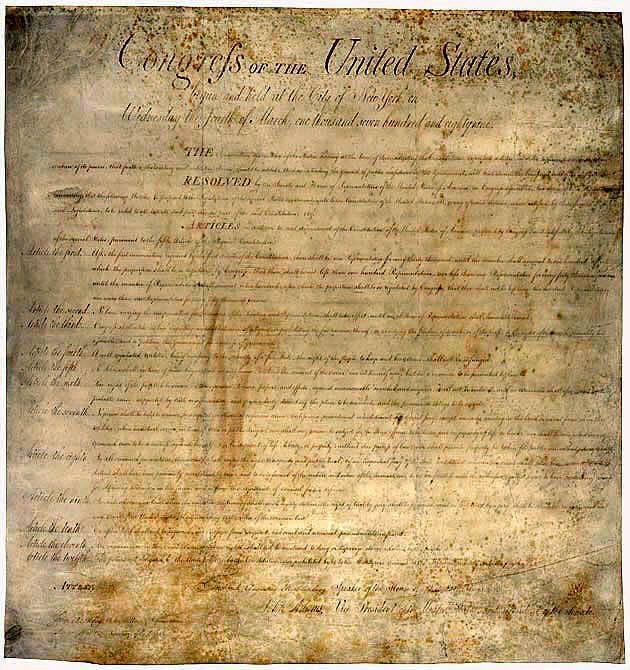
On September 25, 1789, the First Congress approved and proposed twelve amendments to the newly ratified U.S. Constitution, sending them to the states for ratification. The action responded in large part to Anti-Federalist critics, who feared that the new national government lacked explicit constitutional protections for individual liberties and could become too powerful.
Representative James Madison introduced and led the effort for the amendments. Although Congress sent twelve proposed articles to the states, only Articles Three through Twelve won ratification by the required three-fourths of state legislatures on December 15, 1791. Those ten articles became the first ten amendments to the Constitution—the Bill of Rights.
The first proposed article, concerning the size and apportionment of the House of Representatives, was never ratified. The second proposed article, limiting congressional pay changes before an intervening House election, was eventually ratified in 1992 as the Twenty-seventh Amendment.
Congress’s September 25 vote was a defining moment in American constitutional history. The Bill of Rights established enduring protections for freedoms including religion, speech, press, peaceful assembly, and petition, as well as rights connected to criminal procedure, due process, and trial by jury.
Image: The U.S. Bill of Rights, via Wikimedia Commons (public domain).
