
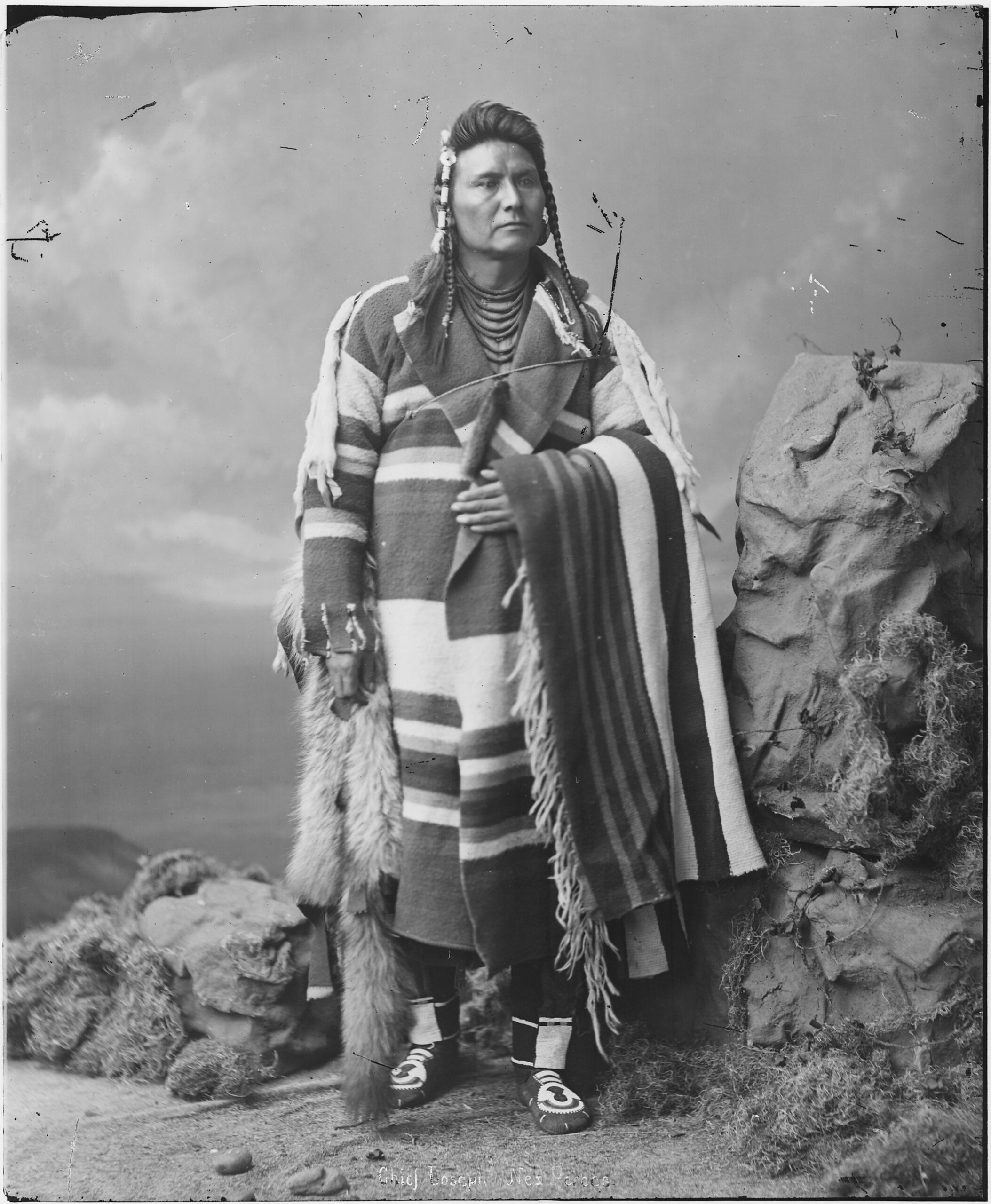
On September 21, 1904, renowned Nez Perce leader Chief Joseph—known in his language as Hin-mah-too-yah-lat-kekt, often rendered “Thunder Rolling Down the Mountain”—died at his home on the Colville Indian Reservation in Washington. He was sixty-four. According to the physician who attended him, Joseph died “of a broken heart,” bringing to a close the life of one of the most eloquent and enduring advocates for Indigenous justice in United States history.
Joseph achieved national and international prominence in 1877, when he and other Nez Perce leaders guided their people on a nearly 1,200-mile flight through Oregon, Idaho, and Montana. Pursued by the U.S. Army after being ordered from their Wallowa Valley homeland, they sought refuge in Canada, where Sitting Bull and other Lakota had fled the previous year. The journey ended in Montana’s Bear Paw Mountains, about 40 miles south of the Canadian border, where the Nez Perce were forced to surrender on October 5, 1877.
At the surrender, Joseph delivered—or, more precisely, was later credited with—the words that became inseparable from his legacy: “From where the sun now stands, I will fight no more forever.” The exact English-language text was recorded through translation and remains subject to historical qualification, but the sentiment has endured as a powerful expression of grief, resolve, and responsibility for his people.
For the rest of his life, Joseph used his visibility to press federal officials, including Presidents Rutherford B. Hayes and Theodore Roosevelt, to permit the Nez Perce to return to their ancestral Wallowa Valley homeland. Instead, he and many of his people remained far from Oregon, eventually living on the Colville Reservation in Washington. His death remains a somber milestone in the history of the American West and in the continuing struggle for Indigenous sovereignty, land, and justice.
