
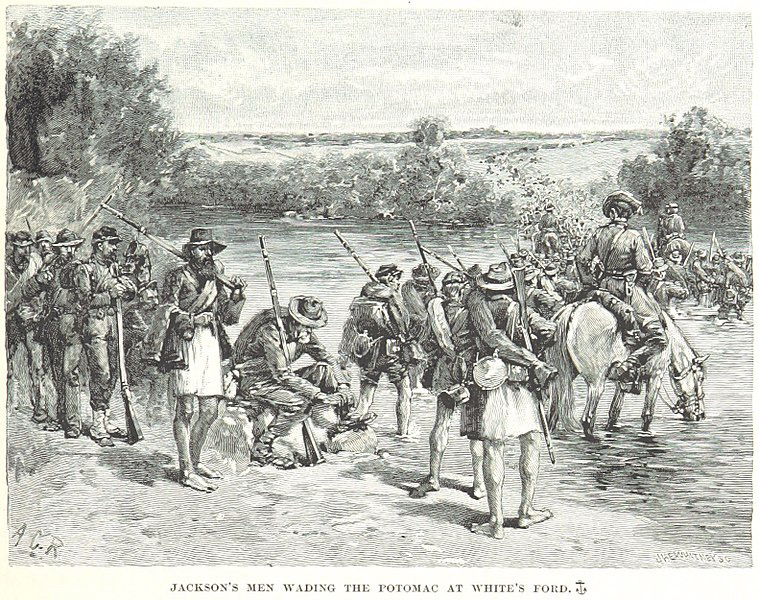
On September 5, 1862, Confederate troops under General Thomas “Stonewall” Jackson crossed the Potomac River at White’s Ford and entered Maryland, a dramatic moment in General Robert E. Lee’s first invasion of Union territory. The movement was part of a broader, staggered crossing by the Army of Northern Virginia, which began on September 4 and used multiple fords along the Potomac as Lee launched the Maryland Campaign.
Fresh from his victory in the Second Battle of Bull Run, Lee carried the war north for strategic, logistical, and political reasons. An invasion of Maryland could temporarily remove Confederate forces from Virginia’s exhausted farmland, enable the army to gather food and other supplies, and place pressure on Northern public opinion ahead of the fall elections. Lee also hoped that a successful Confederate advance into the slaveholding border state might attract Maryland recruits and persuade Britain and France that the Confederacy could sustain a successful war on Northern soil.
The sight of thousands of battle-hardened Confederate soldiers—many poorly equipped and some barefoot—crossing into Maryland transformed the war’s immediate strategic situation. Jackson’s command formed an important part of the advancing force, while Lee concentrated his army around Frederick. The invasion forced Major General George B. McClellan and the Army of the Potomac to move quickly from the defenses of Washington in pursuit of Lee’s army.
Over the next twelve days, Lee’s gamble produced a rapid and brutal campaign across western Maryland. Confederate forces captured Harpers Ferry, fought Federal troops at South Mountain, and then faced McClellan along Antietam Creek on September 17. The Battle of Antietam was the bloodiest single day in American military history. Although tactically inconclusive, it stopped Lee’s 1862 invasion and led him to withdraw the Army of Northern Virginia back across the Potomac into Virginia.
Image: “Jackson’s men wading the Potomac at White’s Ford,” by Allen Christian Redwood, engraved by John Henry Ellsworth Whitney; via Wikimedia Commons, public domain.
