
On September 3, 1781, the Pennsylvania State House—the historic building later known universally as Independence Hall—stood at the center of a grand military procession through Philadelphia. French troops under the Comte de Rochambeau marched in ceremonial formation before members of the Continental Congress and Generals George Washington and Rochambeau. Their white uniforms and marching bands made the parade a vivid public expression of the Franco-American alliance as the allied armies moved toward the Yorktown campaign.
As the French troops passed the State House, its original wooden steeple still rose above the building. Added around 1750 to house the Liberty Bell, the structure was tall but badly decayed. The Pennsylvania legislature had already described it as being in “ruinous” condition by 1774, and it was removed later in 1781 because it had become unsafe. The brick tower was then covered with a low hipped roof, leaving the building without a steeple for nearly five decades.
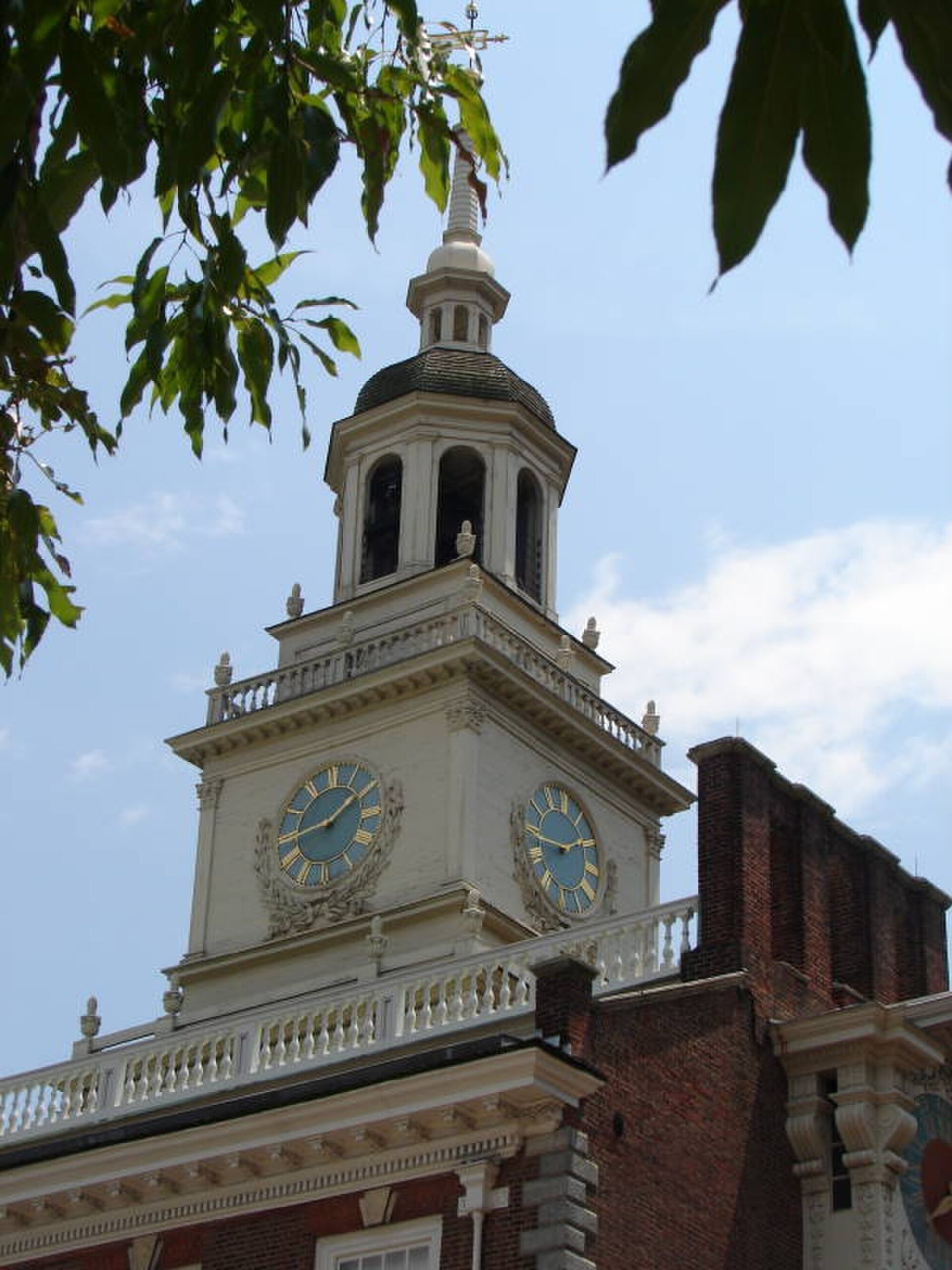
The elegant steeple familiar to modern visitors is not the one Washington or Rochambeau saw. Designed by William Strickland and completed in 1828, it recreated the general form and height of the older structure but introduced a distinctly 19th-century interpretation, including four clock faces. The original Revolutionary-era steeple had no clocks.
The architectural reality is therefore more subtle—and perhaps more interesting—than the usual image suggests. Independence Hall did possess a prominent steeple when the Declaration of Independence was adopted in 1776 and when the French army marched past in 1781. But it was an aging, clockless wooden structure, soon to disappear. The iconic clock tower now associated with the Revolution is a later reconstruction, shaped by early American historic preservation and 19th-century architectural taste rather than a literal survival from 1776.
Image: Independence Hall via Wikimedia Commons, CC BY 2.0
