
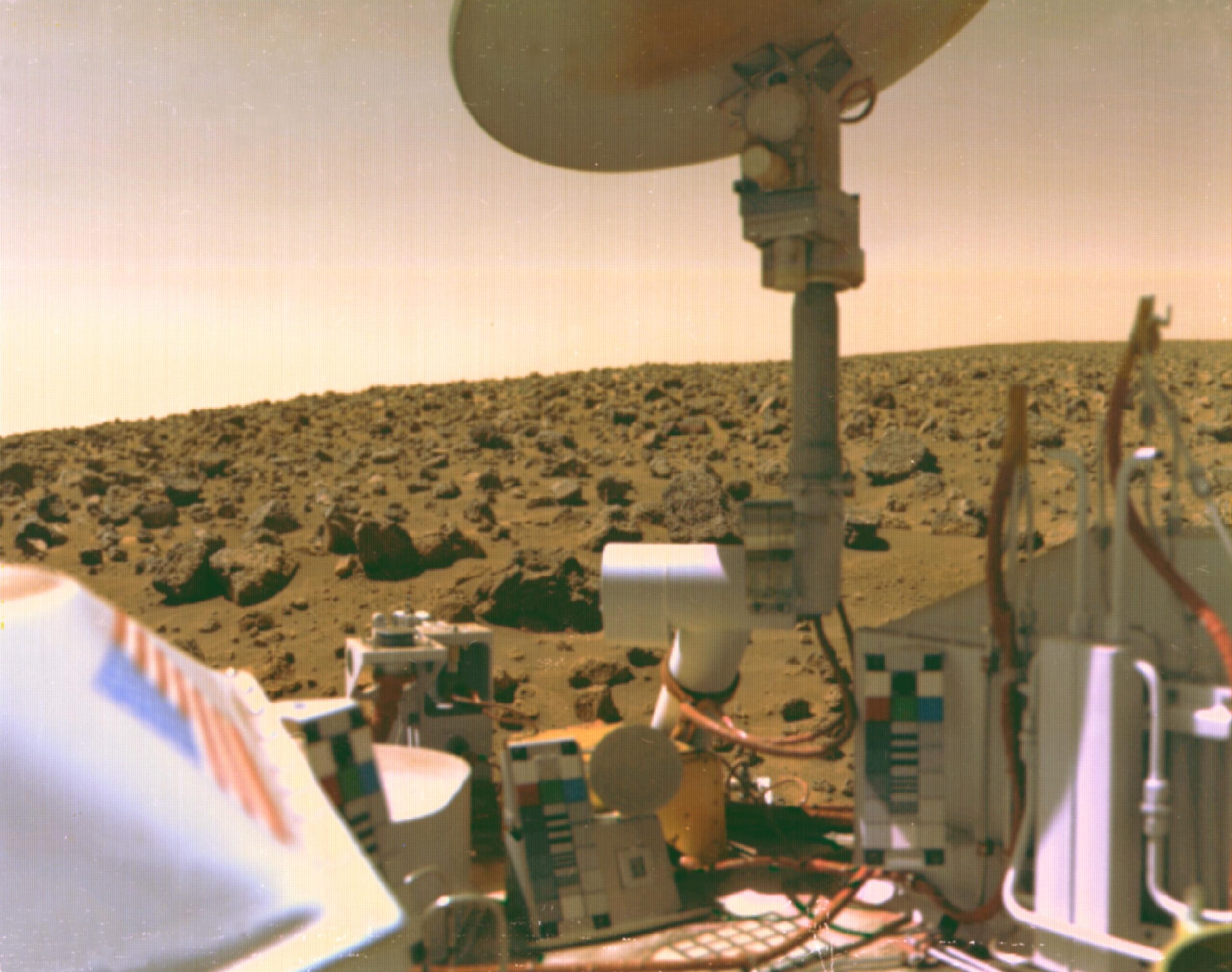
On September 3, 1976, NASA’s Viking 2 lander completed a successful descent through Mars’s thin atmosphere and touched down on the rock-strewn plains of Utopia Planitia. Launched from Earth nearly a year earlier, Viking 2 became the second spacecraft in NASA’s Viking program to land safely on Mars, following Viking 1’s arrival in Chryse Planitia in July. Soon after landing, Viking 2 began returning images of its surroundings—including an early color view of the northern Martian surface—to scientists on Earth.
Viking 2 was a landmark of 1970s planetary exploration. Its lander operated for 1,316 Earth days, collecting weather observations, photographing the landscape, and using a mechanical arm to deliver Martian soil to an onboard laboratory. Along with its twin mission, Viking 2 helped reveal Mars as a geologically varied world shaped by volcanism, impact cratering, wind, and a history involving water and ice.
Its most enduring legacy, however, lies in an unresolved scientific puzzle. Viking 2 carried three biological experiments designed to search for microbial activity, as well as a gas chromatograph–mass spectrometer, or GCMS, intended to detect organic molecules in the soil. The Labeled Release experiment produced a striking response: after nutrients containing radioactive carbon were added to a soil sample, radioactive gas was released in a pattern that some researchers argued was consistent with microbial metabolism.
Yet the GCMS found no organic compounds at the levels it was designed to detect, and the other experiments did not yield a clear, unified biological signal. NASA therefore concluded that the results did not provide convincing evidence of life, with reactive Martian soil chemistry considered the more likely explanation. The data have never entirely lost their power to provoke debate: Viking 2 did not prove that Mars was alive, but it left behind one of planetary science’s most tantalizing ambiguities.
Image: Viking 2’s first color view of the Utopia Planitia landing site, NASA/JPL, public domain
