
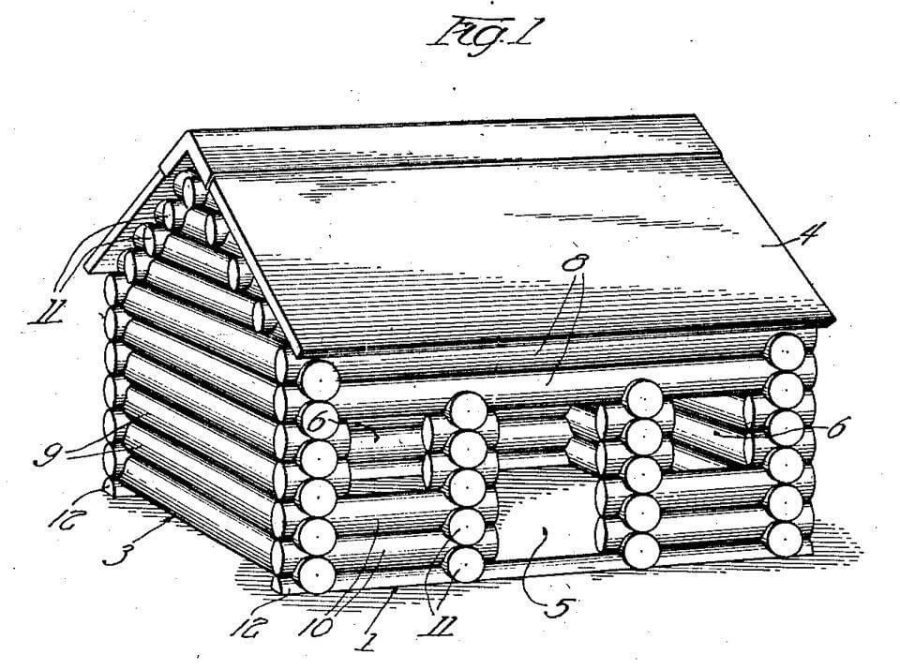
On August 31, 1920, architect and inventor John Lloyd Wright received U.S. Patent No. 1,351,086 for “Toy-cabin construction,” a building set made from small, notched pieces designed to resemble logs. The patent describes how the pieces interlock at the corners, allowing children to assemble stable miniature log cabins complete with walls, gables, and roof elements.
Wright—the son of architect Frank Lloyd Wright—developed the idea after working with his father in Japan on Tokyo’s Imperial Hotel. Accounts of the toy’s origin connect its interlocking design to structural ideas Wright encountered during that project, which was conceived with earthquakes in mind. He began marketing the construction toy in 1918 through the Red Square Toy Company; it later became known as Lincoln Logs.
The appeal of Lincoln Logs lay in its elegant simplicity: a small set of repeated wooden parts could produce many different structures, while the notches taught the basic logic of interlocking construction through play. The patent remains a notable example of architectural thinking translated into a durable children’s toy, establishing a standardized childhood staple that leaned heavily on early American frontier design to carve out a permanent niche within popular consumer culture.
Image: Patent drawing from John Lloyd Wright’s 1920 “Toy-cabin construction” patent, showing the notched log components and their assembly into a miniature cabin. (Image via Wikimedia Commons, public domain).
