
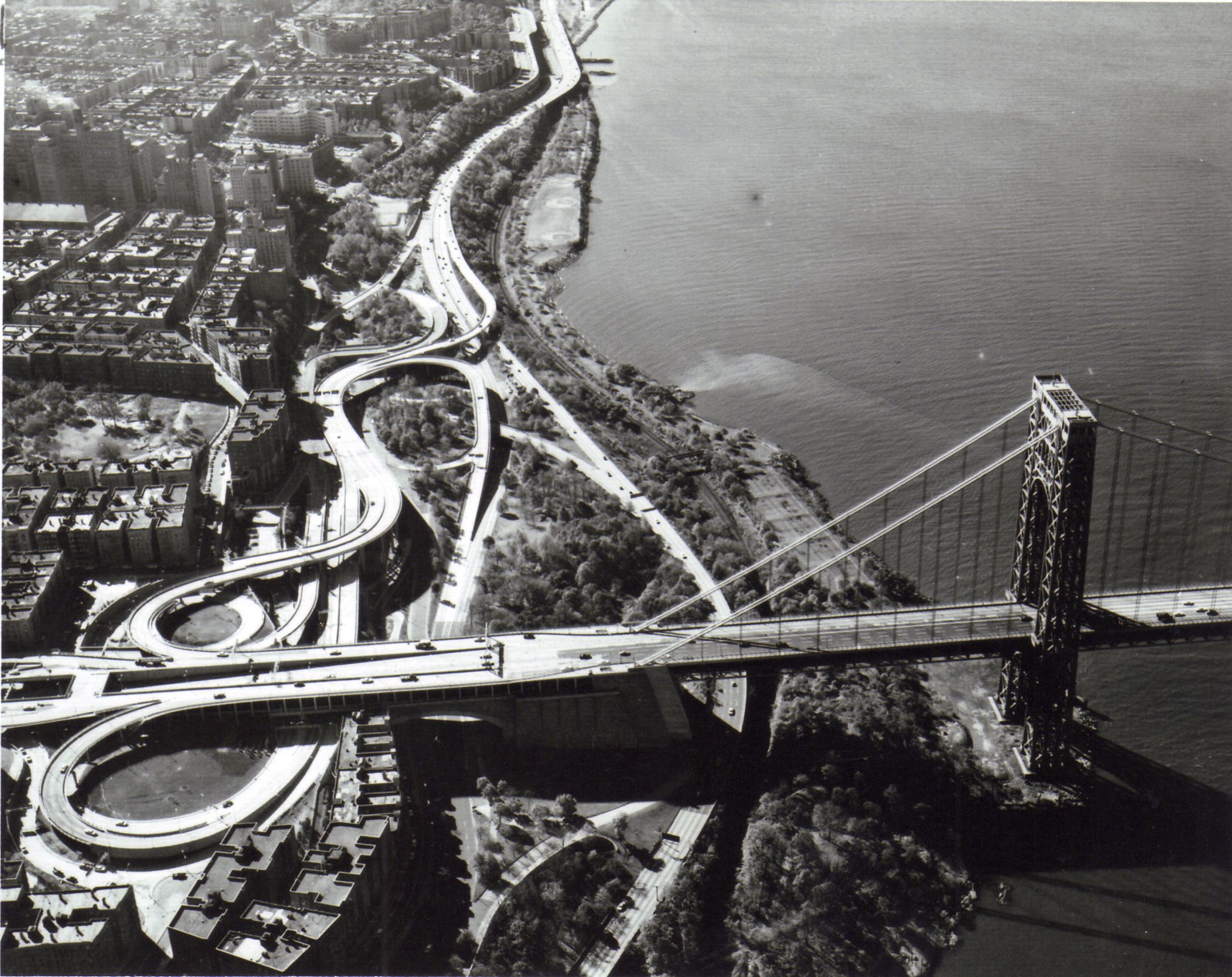
On August 29, 1962, the Port Authority of New York and New Jersey opened the six-lane lower level of the George Washington Bridge. Added beneath the bridge’s original roadway, the new deck gave the crossing a total of 14 traffic lanes—eight on the upper level and six below—and increased its capacity by roughly 75 percent. At the time, it made the George Washington Bridge the world’s only 14-lane suspension bridge.
The project fulfilled a possibility built into Othmar H. Ammann’s original design. When the bridge opened in 1931, its 3,500-foot suspension span and steel towers had been engineered to support two roadway or rail levels. As traffic grew, the Port Authority first opened two formerly unpaved center lanes on the upper roadway in 1946, then began work on the lower deck in 1959. The lower roadway was completed in 1962, with construction involving the installation of 76 large steel sections while traffic continued on the upper deck.
The expansion did not solve every regional transportation problem, but it became a lasting example of how a bridge designed with reserve structural capacity could be adapted decades later to meet metropolitan traffic demand.