
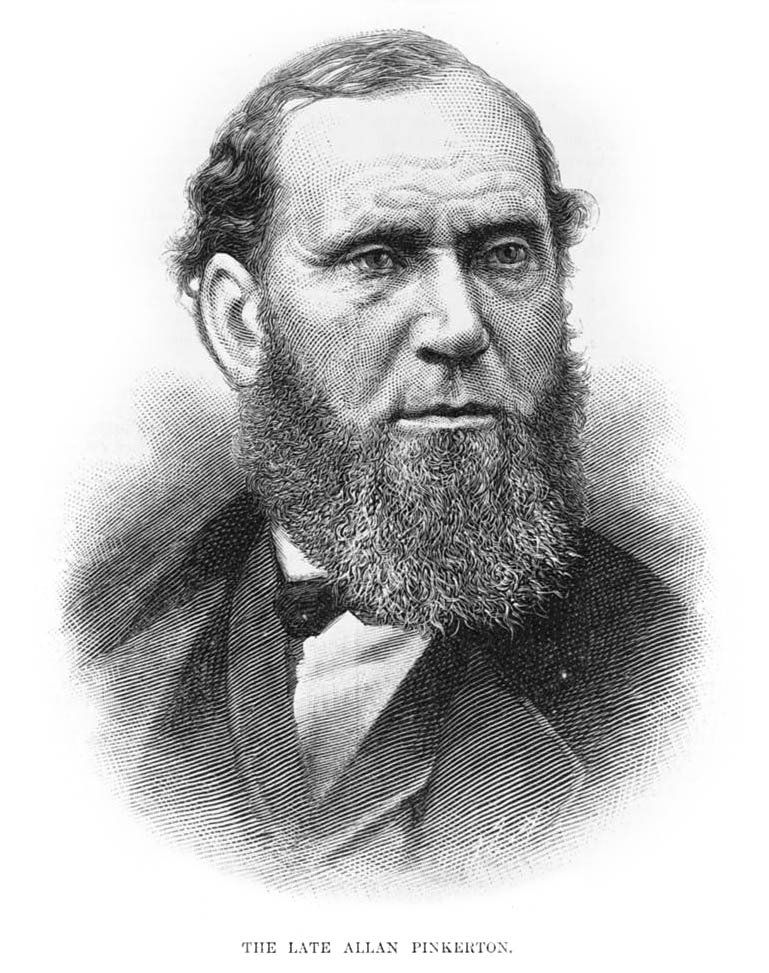
Allan Pinkerton was born on August 25, 1819, in Glasgow, Scotland. After emigrating to the United States and serving as Chicago’s first police detective, he founded the Pinkerton National Detective Agency, creating the country’s most influential private investigative and security organization of the nineteenth century.
Pinkerton’s arrival on the American scene introduced a fiercely disciplined investigator whose methods reshaped the nation’s developing security culture. In early 1861, as Abraham Lincoln traveled to Washington for his inauguration, Pinkerton uncovered and helped thwart the Baltimore assassination plot, prompting Lincoln to rely on him for personal protection during the dangerous opening months of the Civil War. Soon after, Major General George B. McClellan placed Pinkerton in charge of the Union Army’s intelligence operations, where he developed structured systems for reconnaissance, counterespionage, and field reporting.
Although the U.S. Secret Service was founded independently in 1865 to combat counterfeiting, Pinkerton’s wartime intelligence work provided one of the earliest large‑scale models for organized information gathering in federal operations. His agency’s postwar activities—tracking train robbers, infiltrating criminal networks, and providing security for major corporations—demonstrated how private investigative techniques could evolve into national‑level security practices. Pinkerton’s long career remains a revealing record of early American statecraft, illustrating how one immigrant detective helped shape the foundations of modern investigative procedure and counterintelligence strategy.
Image via Wikimedia Commons, public domain in the U.S.
