
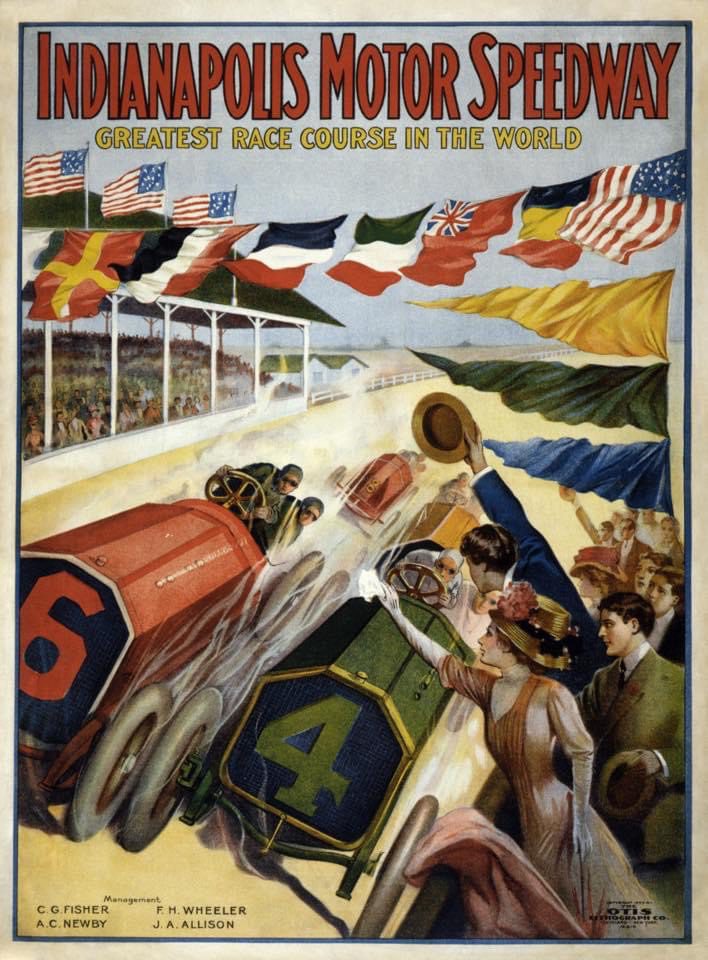
On August 19, 1909, the first auto race began at the Indianapolis Motor Speedway. The track basically consisted of packed dirt and crushed stone that flew into the faces of drivers as they competed in their early open air vehicles.
The inaugural race weekend on August 19th was a chaotic, high-stakes spectacle that pushed early twentieth-century automotive engineering and human endurance past their absolute breaking limits. Co-founded by visionary businessman Carl Fisher to serve as a premier testing ground for the burgeoning American automotive industry, the massive, two-and-a-half-mile oval originally lacked any asphalt or concrete reinforcement. As the primitive, high-horsepower racing machines thundered down the straightaways at unprecedented speeds, their heavy rubber tires rapidly chewed through the packed earth, unleashing a blinding, lethal deluge of gravel, oil, and dust that blanketed the competitors.
The treacherous track conditions quickly triggered a series of catastrophic, high-speed tire blowouts and mechanical failures that resulted in multiple fatalities, throwing the crowd of tens of thousands into an immediate wave of shock. Recognizing that the track surface was a deadly hazard, Fisher immediately halted further competition, ordering a total engineering overhaul that required the laying of over 3.2 million uniform paving bricks to stabilize the course. This massive, multi-ton reconstruction single-handedly earned the legendary circuit its permanent, immortal nickname—”The Brickyard”—and laid the structural foundation for the modern era of professional motorsport safety.
Image: A vintage 1909 lithograph poster promotes the inaugural race weekend at the newly constructed Indianapolis Motor Speedway via Wikimedia Commons, public domain
