
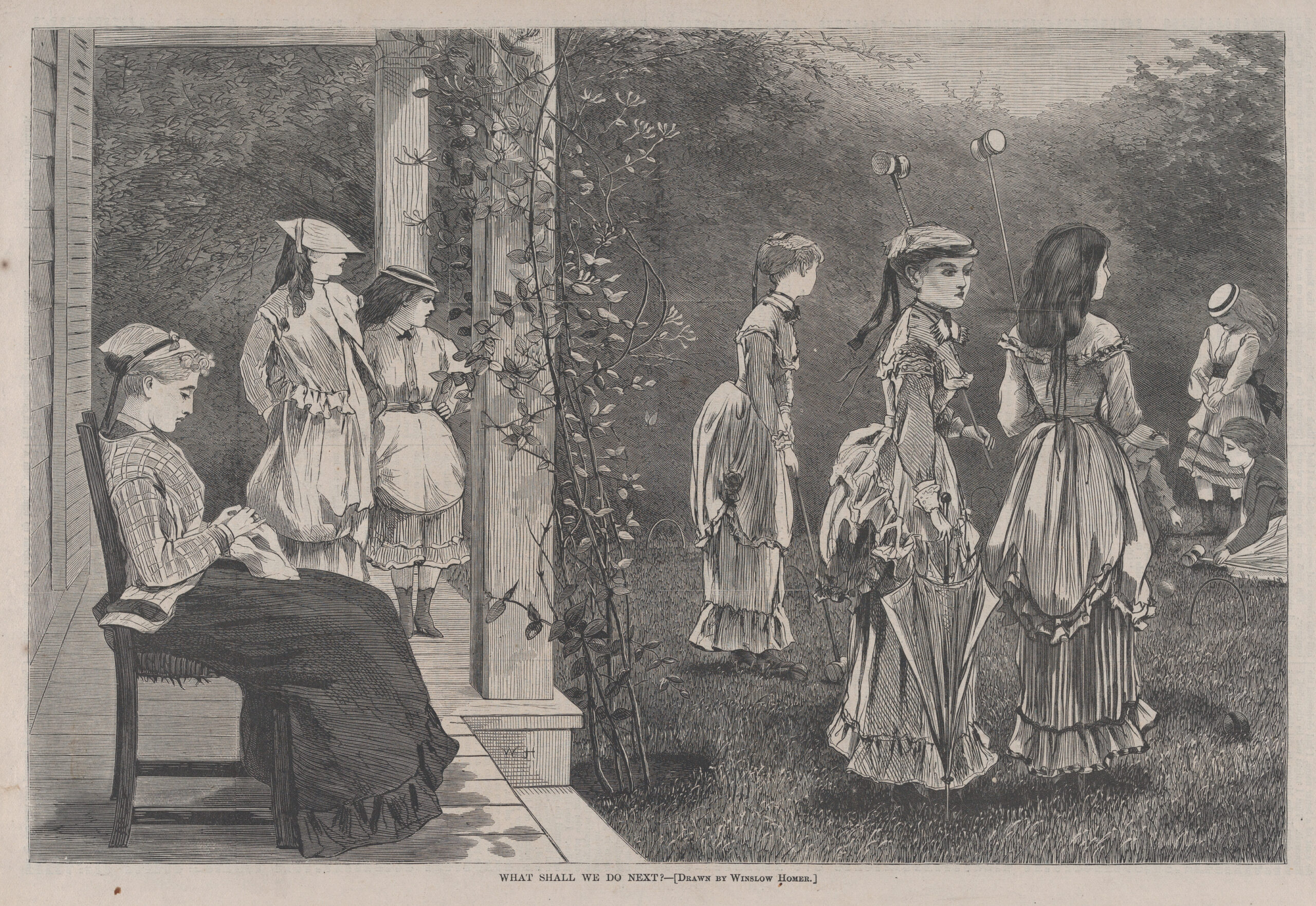
Several young women gather in a sun-dappled garden in Winslow Homer’s engraving “What Shall We Do Next?”, published in Harper’s Bazar on July 31, 1869. Their figures are arranged like punctuation marks across a summer afternoon, some with croquet mallets and parasols, while others sit, reserved, or contemplative. The scene is brimming with the paraphernalia of fashionable leisure—but not action, marked instead by a collective hesitation. Published just four years after the Civil War, this engraving functions as an emotional mirror for a deeply traumatized nation trying to adjust to an uneasy peace.
The physical stillness of the women masks an underlying psychological restlessness, capturing a moment where the old world had vanished but the new one remained undefined. Homer captures a collective pause, a moment where the frantic pulse of wartime panic slows down into an anxious, uncertain domestic serenity. The title’s central question asks more than what game follows next; it probes the uncertain future of Reconstruction and the changing roles of women who had run farms, businesses, and hospitals during the war. Having experienced a taste of independence, these women could not easily slip back into passive social roles, reflecting a generation whose internal world was expanding far beyond the strict boundaries of Victorian propriety.
