
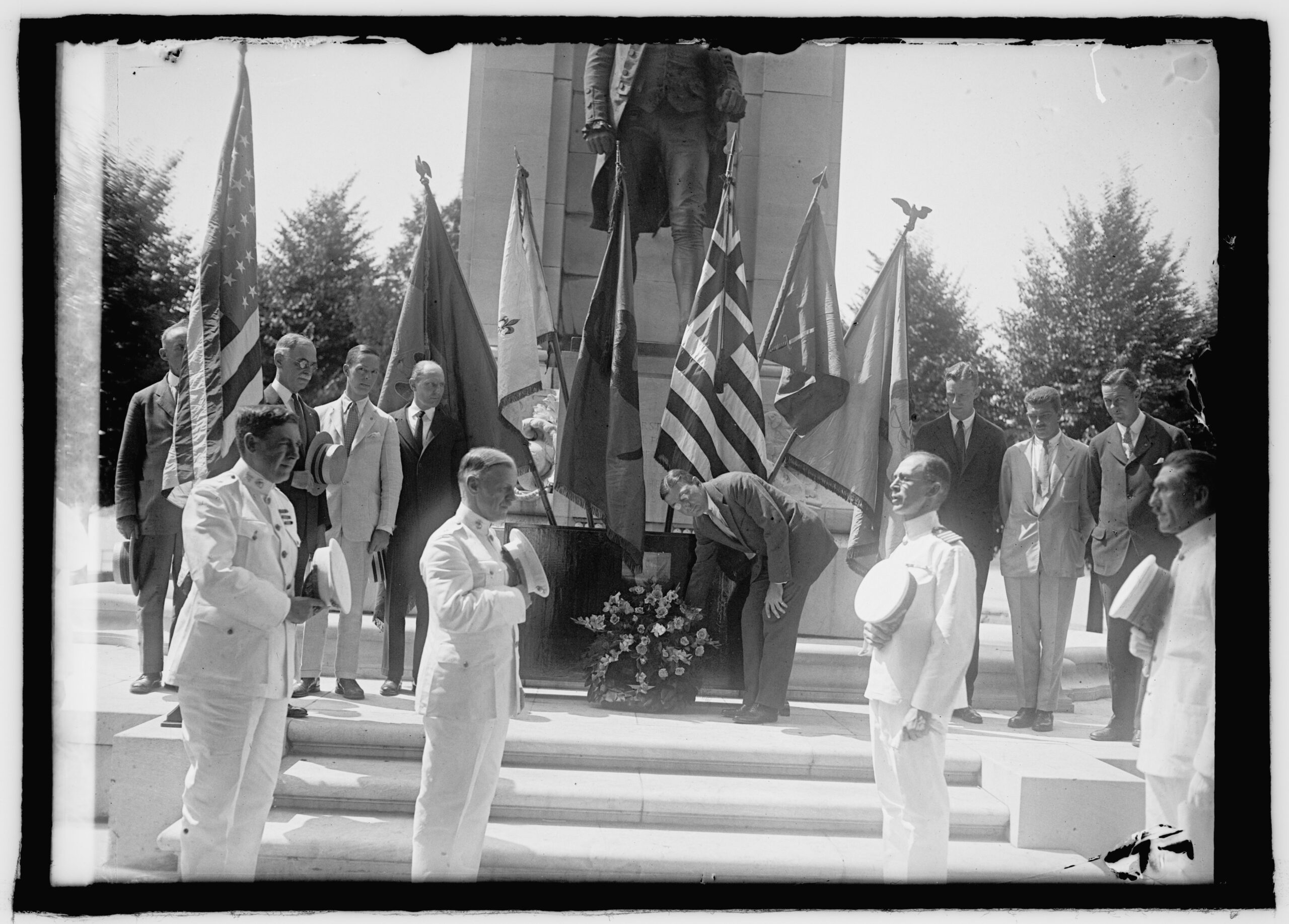
On July 6, 1925, Assistant Secretary of the Navy Theodore Douglas Robinson gathered with naval officers and international dignitaries for an outdoor wreath-laying ceremony honoring the 178th anniversary of John Paul Jones’s birth (image above). Standing in front of a towering public monument, Robinson paid tribute to the legacy of the Revolutionary War commander whose aggressive, unyielding spirit laid the early foundational baseline for the modern United States Navy. The outdoor commemoration highlighted a growing, early twentieth-century movement within the military establishment to actively utilize historical anniversaries to foster institutional pride, unity, and a shared sense of patriotic duty across the service.
The journey of Jones’s memory to this 1925 tribute was shaped by one of the most remarkable and bizarre recovery odysseys in American naval history. Following the conclusion of the American Revolution, the legendary captain died in relative obscurity and poverty in Paris in 1792, where he was buried in a modest Protestant cemetery that was eventually abandoned, built over, and entirely forgotten under decades of urban expansion. It required a massive, meticulous six-year archival excavation spearheaded by Horace Porter, the American Ambassador to France, to finally uncover the lost burial site in 1905, revealing Jones’s remains perfectly mummified within a lead coffin that had been filled with alcohol by a far-sighted French admirer who anticipated that the United States would one day reclaim its premier maritime hero.
President Theodore Roosevelt subsequently dispatched a grand squadron of American warships to escort the commander’s remains across the Atlantic, culminating in a permanent, royal-style re-interment inside a magnificent marble crypt built beneath the Naval Academy Chapel in Annapolis. While Robinson’s outdoor 1925 ceremony captured a public moment of floral remembrance, it mirrored the ongoing traditions maintained inside the stone vaults of the Academy, where midshipmen continuously honor the legacy of the Bonhomme Richard. Today, the archival photograph stands as an enduring monument to the continuity of naval tradition, illustrating how a once-forgotten revolutionary sailor was systematically elevated to become the immortal symbol of American maritime resolve.
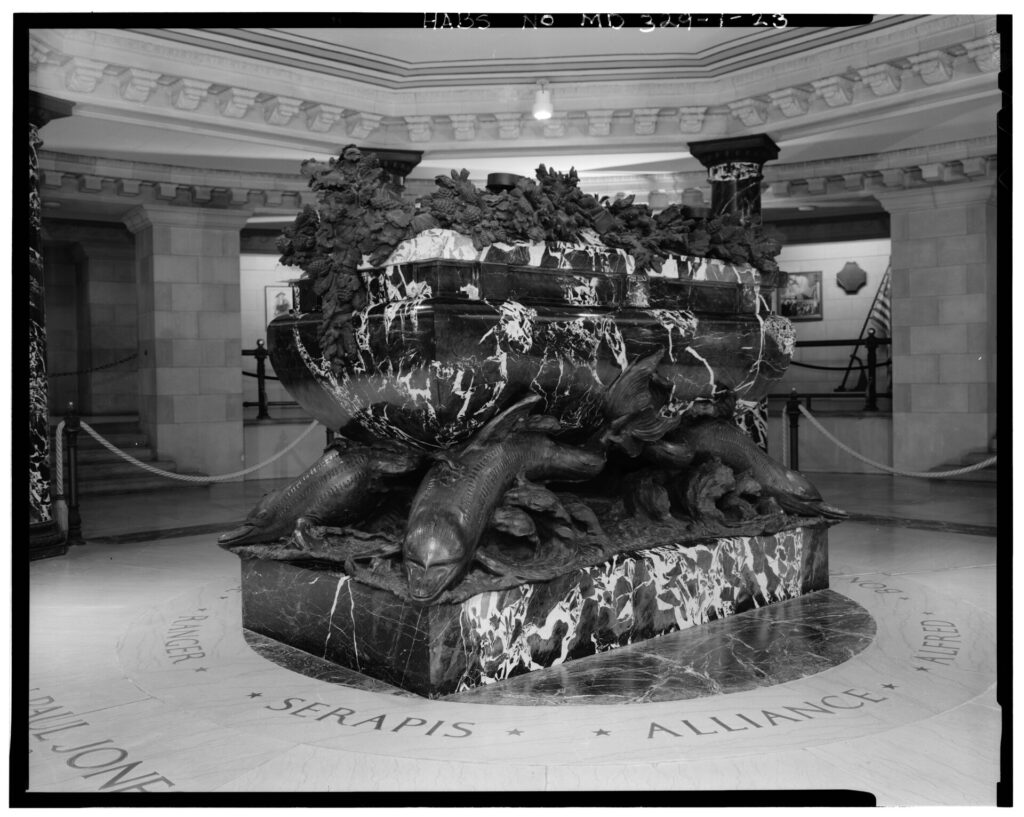
Image: CRYPT, SARCOPHAGUS – U.S. Naval Academy, Academy Chapel, Annapolis via Wikimedia Commons
