
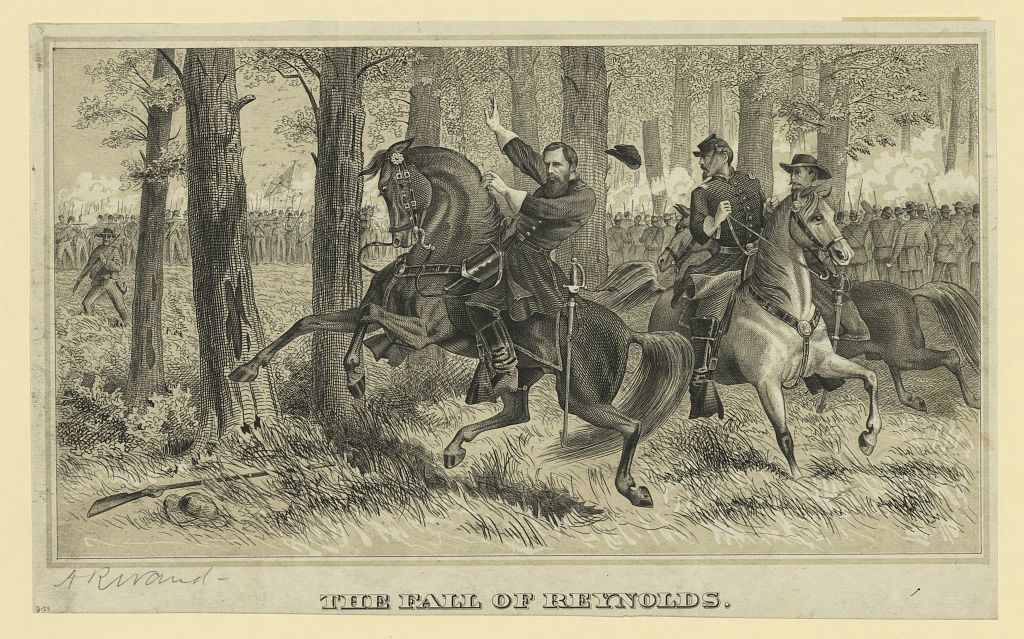
On July 1, 1863, the Battle of Gettysburg erupted when Union Major General John F. Reynolds rode onto the field and immediately recognized the tactical gift before him: the rolling ridges west of town offered the perfect defensive anchor for the Army of the Potomac. He dispatched a courier racing back to General George Meade with an urgent directive — make a stand here.
Minutes later, while personally positioning the veteran troops of the First Corps in a patch of woods, a Confederate sharpshooter’s bullet struck Reynolds in the neck. He toppled from his horse and died instantly, leaving the Union’s forward line leaderless at the moment of first contact. The outnumbered Federals fought savagely through the afternoon until the failing light forced them back to the high ground above Gettysburg — the very position Reynolds had chosen.
In the decades after the war, Reynolds’ death became a symbol of noble sacrifice, even inspiring a 1914 poem by writer Stephen B. Day, who lamented how many Union dead were stripped and left “unknown” on that chaotic field. But Day’s elegy left out one haunting truth: Reynolds himself narrowly escaped that fate. His staff recovered his body almost immediately, and inside his uniform they found a gold ring engraved “Dear Kate,” the secret token of his private engagement to Catherine “Kate” Hewitt. Before he left for the front, the two had vowed that if he fell in battle, she would enter a convent. After Gettysburg, Hewitt kept her promise, vanishing into religious silence while Reynolds’ name ascended into national memory — carved into marble, mourned by the Army, and forever tied to the ridge he died securing.
