
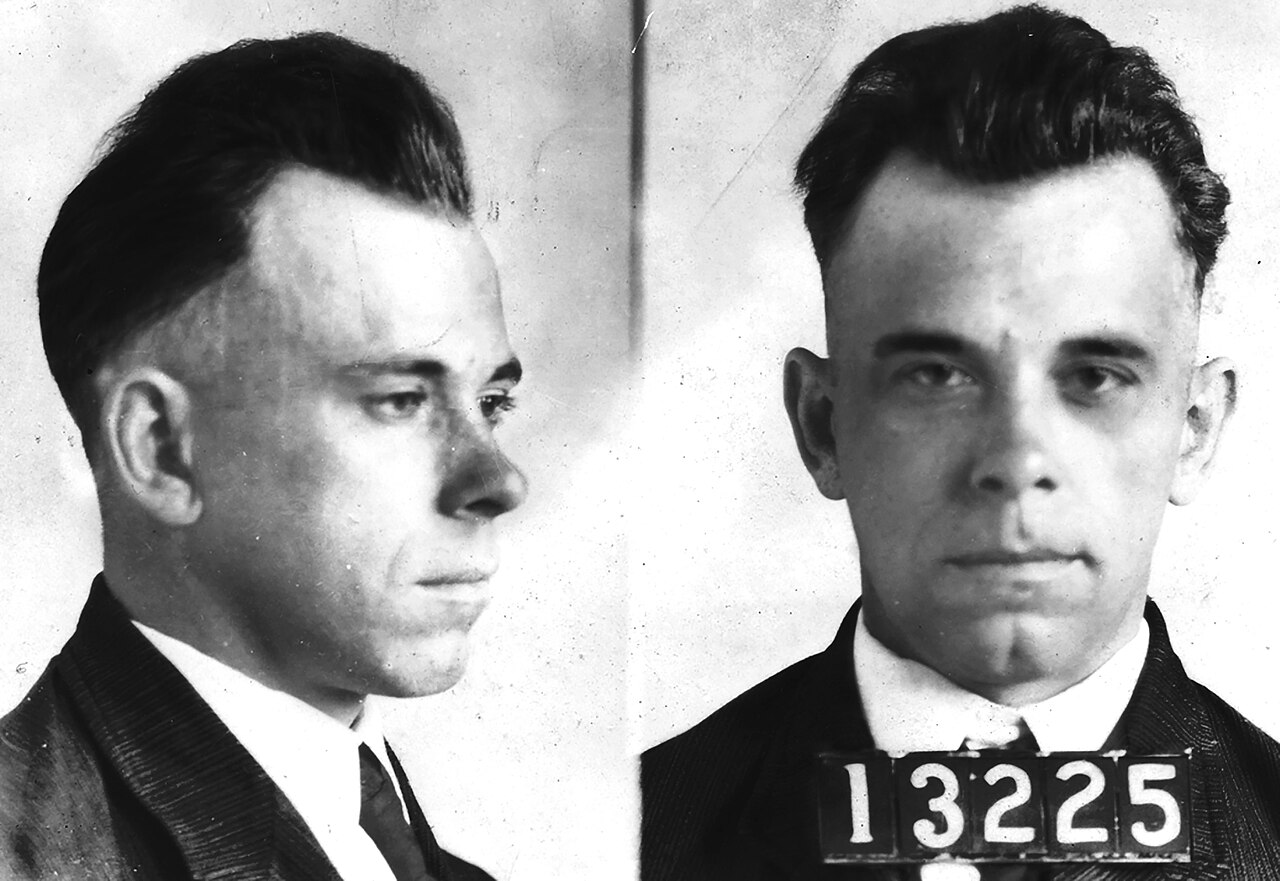
Born in Indianapolis, Indiana, on June 22, 1903, John Dillinger grew up in a turbulent household marked by the early death of his mother and a strained relationship with his strict father. Though intelligent and athletic, he developed a reputation as a rebellious youth, drifting into petty thefts and street trouble. He briefly attempted a respectable life—marrying young, working in a machine shop, and even enlisting in the U.S. Navy—but he deserted from the USS Utah in 1923 and was officially listed as a fugitive from military service. A botched robbery at age twenty-one resulted in a devastating 10‑to‑20‑year prison sentence, a punishment so severe for a first offense that Dillinger later said it “made him a criminal.” After serving more than eight years, he emerged hardened, deeply embittered, and connected to seasoned convicts who would soon become his partners in crime.
Operating with a heavily armed gang, Dillinger terrorized the American Midwest by robbing a dozen banks, executing daring jailbreaks, and consistently outmaneuvering local law enforcement networks. His theatrical criminal exploits—often leaping completely over high bank counters, earning him the press nickname the “Jackrabbit”—captured the imagination of a desperate, cynical public during the Great Depression. Although his gang killed several police officers in violent shootouts, Dillinger himself was never definitively proven to have personally taken a life. The one murder charge brought against him—the killing of East Chicago Officer William O’Malley—never went to trial after Dillinger escaped jail with a carved wooden gun.
Dillinger’s high-profile crime wave inadvertently laid the groundwork for the modern federal law enforcement system. Frustrated by state lines that blocked local police pursuit, Congress passed a series of 1934 “Dillinger Laws” that expanded federal jurisdiction, armed federal agents, and transformed the Bureau of Investigation into the FBI. The Bureau’s relentless pursuit of Dillinger, culminating in his fatal shooting outside a Chicago theater, marked the moment when federal policing became a centralized national power.
Image via Wikimedia Commons, public domain
