
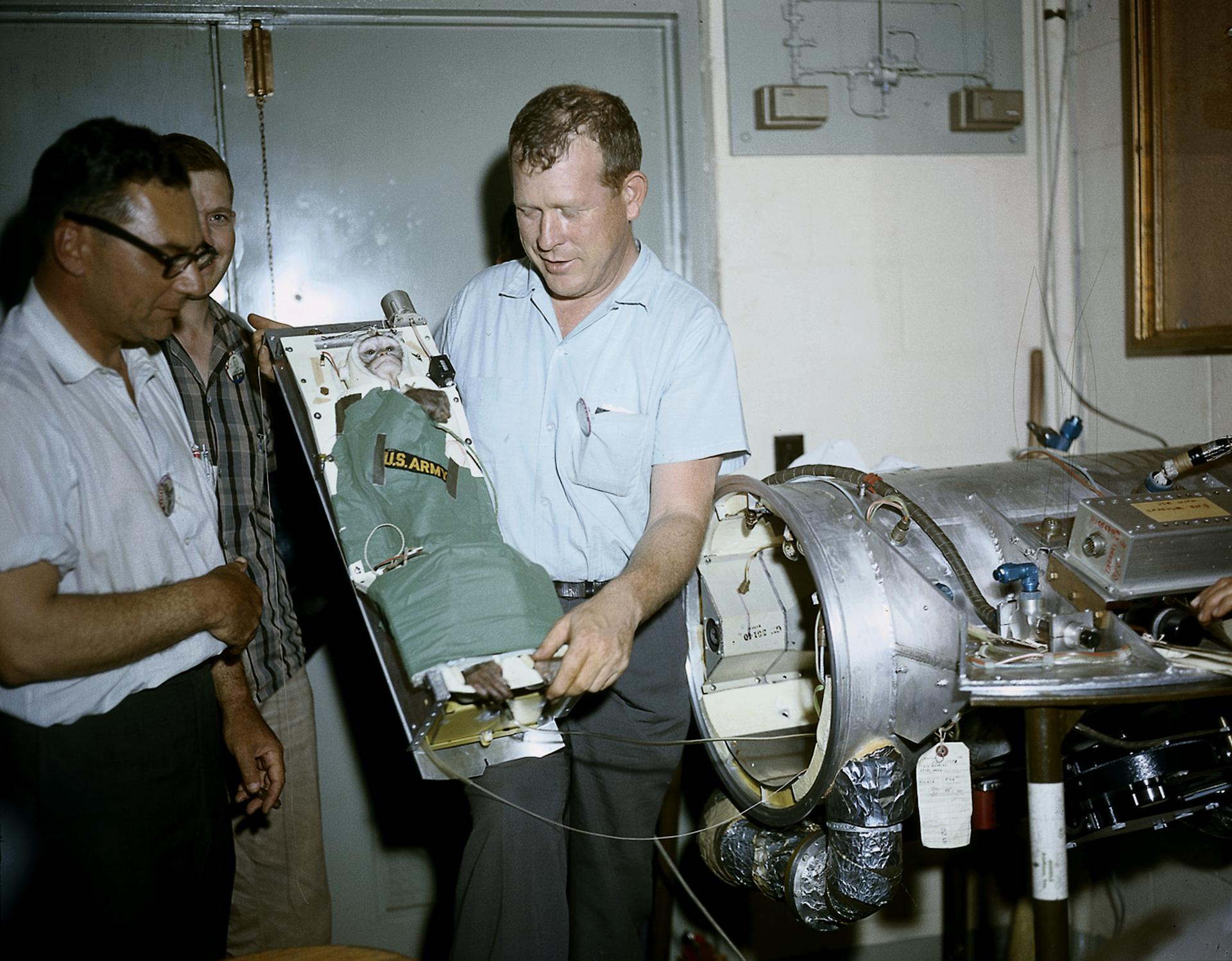
In this pre‑flight test scene from early 1959, Able, a rhesus monkey selected for America’s biological space research program, is secured inside her custom‑built U.S. Army flight capsule during preparations for the Jupiter AM‑18 mission. Engineers and medical personnel conducted extensive ground tests like this one to verify life‑support systems, biomedical sensors, and the structural integrity of the capsule before committing to launch.
Jupiter AM‑18 lifted off from Cape Canaveral on May 28, 1959, carrying Able and Baker, a squirrel monkey, on a suborbital flight that traveled more than 1,700 miles downrange and provided roughly nine minutes of weightlessness. Their safe recovery marked the first time primates survived a spaceflight, offering crucial biomedical proof that complex mammals — and soon humans — could withstand the stresses of launch, microgravity, and reentry.
Though Baker went on to live a long public life until 1984, Able died just four days after the mission, on June 1, 1959, from complications under anesthesia during a routine procedure to remove a biomedical electrode — a poignant footnote to one of the most important biological flights in American space history.
