
On May 23, 1939, the brand‑new submarine USS Squalus slipped beneath the Atlantic for a routine test dive — and never resurfaced. A single valve failure sent a wall of seawater roaring through the aft compartments, killing 26 men instantly. The submarine plunged to the bottom and settled 243 feet down, where no human being had ever been rescued alive.
But in the forward compartments, 33 men survived — trapped in freezing darkness, rationing air, listening to the hull groan under the pressure of the deep.
At that depth, rescue was considered impossible.
No navy on earth had ever pulled men alive from such a grave.
Then came the miracle.
The Navy deployed a brand‑new invention: the McCann Rescue Chamber, a 10‑ton steel diving bell designed to clamp onto a sunken submarine’s escape hatch. It had never been used in a real emergency.
Trip after trip, the chamber descended into the black water, locked onto the Squalus, and hauled survivors back to the surface. It was the first successful deep‑submarine rescue in world history.
But the final lift nearly ended in disaster.
On the fourth trip up — carrying the last survivors — the rescue chamber’s cables jammed. The bell hung suspended in open ocean, swaying in the swell, with the trapped men running out of air. Navy divers had to descend in the dark, manually cut the fouled cables, and guide the chamber up by hand.
The men inside the chamber survived.
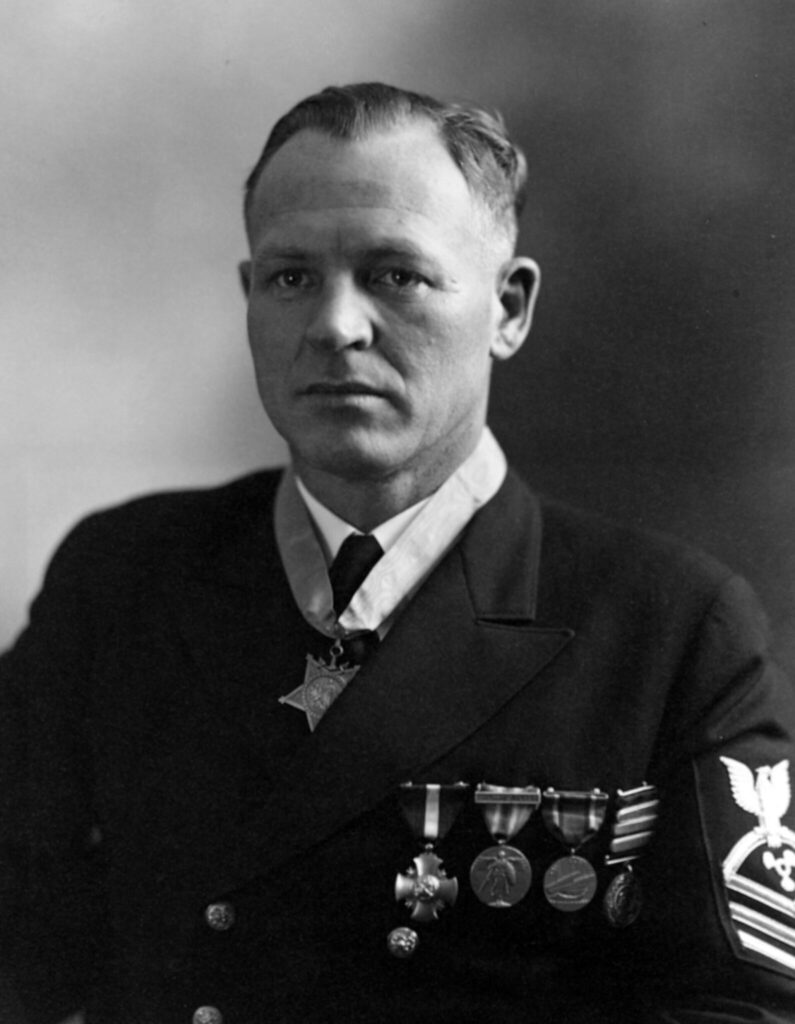
Among the divers was Chief Boatswain’s Mate William Badders (shown), a veteran of the Navy’s Experimental Diving Unit. Working in crushing cold and darkness, breathing the new helium‑oxygen mixture that kept him conscious at depth, Badders helped free the jammed chamber and bring the last survivors home. His actions earned him the Medal of Honor — one of the few ever awarded for non‑combat heroism.
It was a triumph of engineering, courage, and a breakthrough in deep‑sea diving science. Without helium‑oxygen mixtures, the divers would have suffered nitrogen narcosis — a drunken, dreamlike state — long before reaching the wreck.
The story didn’t end there.
The Navy refused to let the Squalus remain a tomb. They raised the submarine from the seafloor, repaired her, and recommissioned her as USS Sailfish. In a twist almost too strange for fiction, Sailfish went on to fight in the Pacific — and in 1943, she sank a Japanese aircraft carrier that happened to be transporting survivors from another lost American submarine.
A ship that died and rose again… sinking a ship carrying men who had survived a different sinking.
The Squalus rescue remains one of the most astonishing survival stories in American naval history — the day 33 men were pulled back from a depth that should have killed them, and lived to tell the tale.
Image: William Badders, photographed on January 19, 1940, after receiving the Medal of Honor for his heroism during the rescue and salvage of USS Squalus. He served as the senior member of the rescue chamber crew and later as a diver during the salvage. His other decorations include the Navy Cross, WWI Victory Medal, and Yangtze Service Medal.