
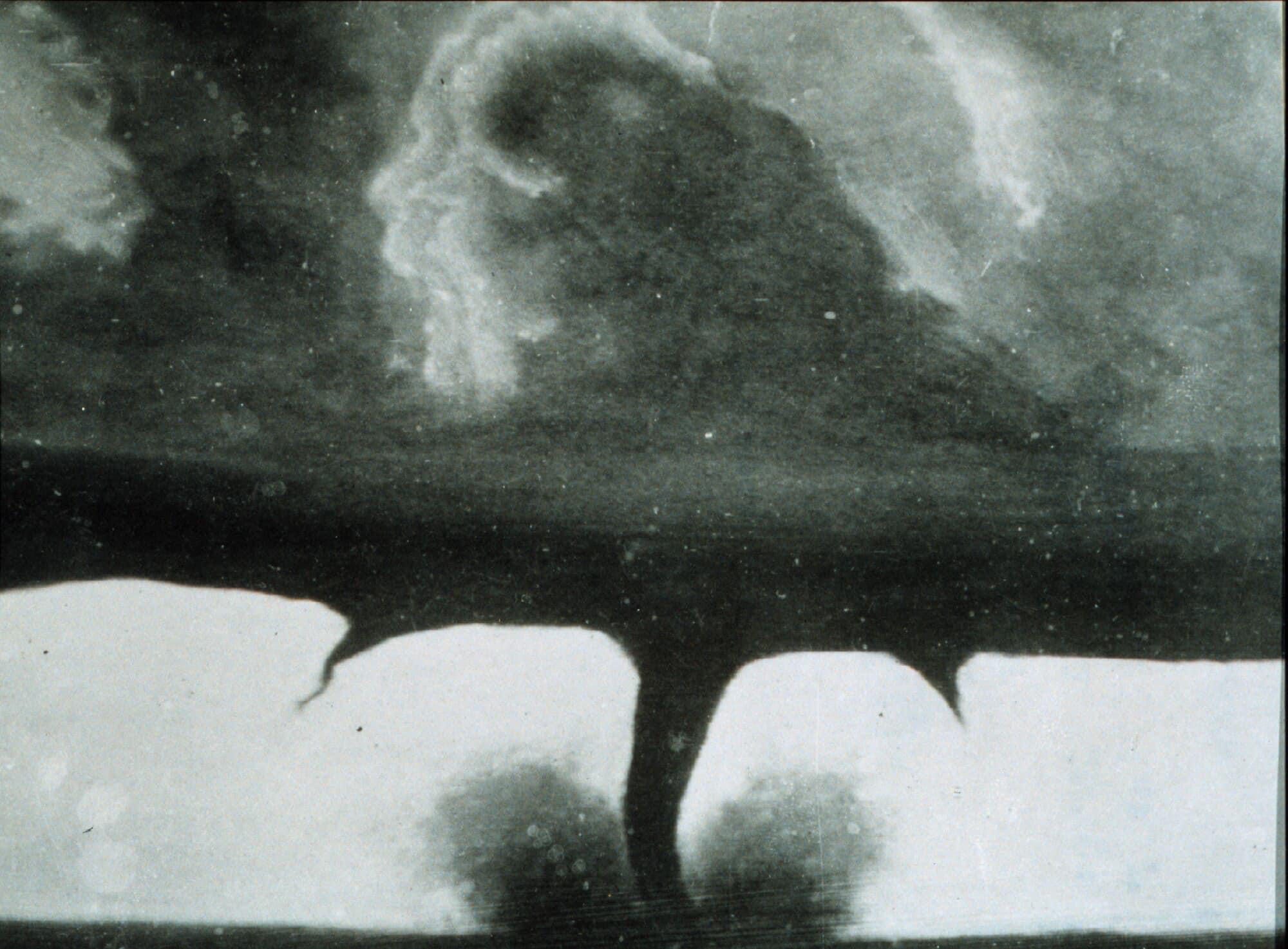
A high‑contrast landscape photograph captured on August 28, 1884 records the dark, well‑defined funnel of a massive tornado moving across the prairie twenty‑two miles southwest of Howard, South Dakota.
The image stands as one of the earliest and most significant photographs of a tornado ever taken. Working under extreme environmental pressure, frontier photographer F.N. Robinson rapidly assembled a heavy wet‑plate camera in the open air, manually adjusting the exposure as the rotating vortex advanced across the landscape. The resulting plate offered atmospheric scientists their first authentic, non‑illustrated view of the physical structure and debris‑cloud geometry of a severe convective storm.
The publication of the Howard photograph circulated widely through national print journals, helping transform the study of extreme weather from speculative frontier folklore into a developing field of visual scientific analysis. The breakthrough allowed early weather bureaus to begin cataloging storm behavior and refining the observational practices that would eventually shape modern forecasting.
The archival print remains a landmark in early American science — proof that the technical agility of a single frontier photographer could capture the fleeting, violent mechanics of the natural world.
Image via Wikimedia Commons, public domain
