
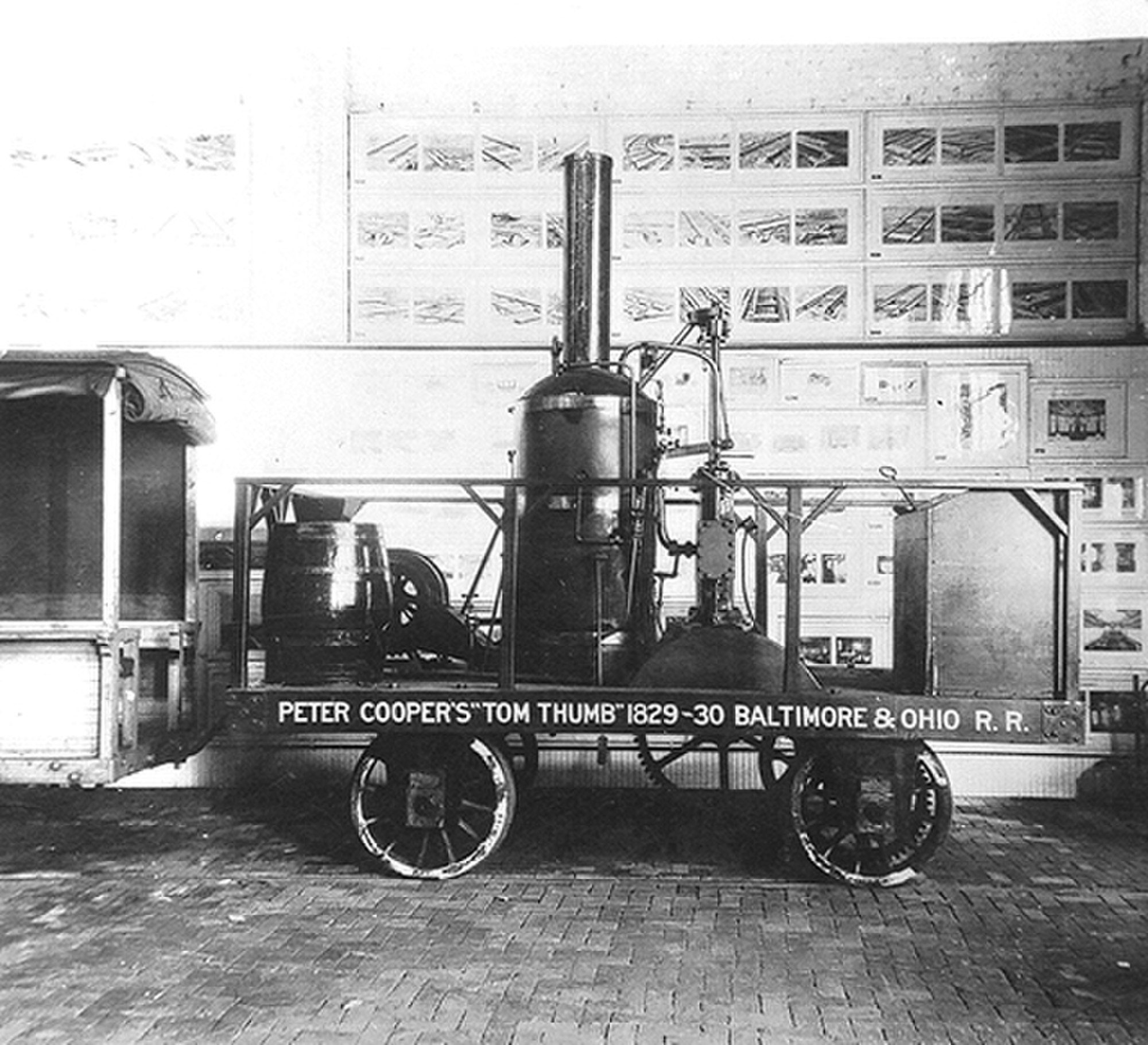
On August 28, 1830, the primitive steam locomotive Tom Thumb, designed and built by industrialist Peter Cooper, executed its historic trial run along the newly laid iron tracks of the Baltimore & Ohio Railroad. The compact experimental machine successfully hauled an open passenger car filled with corporate directors over a thirteen-mile stretch from Baltimore to Ellicott’s Mills, marking a critical milestone in American transportation.
The triumph was a feat of engineering adaptability that overturned assumptions about steam power. Before Cooper’s breakthrough, railroad companies relied on horse-drawn carriages, convinced heavy steam engines could not navigate steep grades and sharp curves. Cooper’s innovative use of small, high-pressure boiler tubes—fashioned from discarded musket barrels—proved that anthracite coal-powered locomotives could out-accelerate and out-haul animal power.
The demonstration triggered a wave of railway construction across the eastern seaboard, prompting planners to abandon canal projects in favor of rapid iron transport networks. This shift unified distant agricultural markets with manufacturing centers, accelerating the velocity of American commerce. The trial remains a landmark of industrial modernization, capturing the mechanical pivot point that launched the American railroad era.
Image: A 1927 replica of Peter Cooper’s Tom Thumb (Wikimedia Commons, public domain).
