Revolutionary War patriot and Major General John Stark was born on August 28, 1728, in Londonderry, New Hampshire. The second son of Archibald Stark—a Glasgow‑educated scholar who joined the historic 1720 Scotch‑Irish migration to New England—young John grew up on a raw frontier that demanded stamina, precision, and a near‑instinctive mechanical skill. Even his family name, drawn from the German starr meaning stiff, rugged, or strong, reflected a lineage hardened by generations of conflict and survival stretching back to Europe.
Stark’s early adulthood forged the exact tactical instincts he would later use to defend the American cause. Alongside his three brothers, he served in the French and Indian War as a captain in the elite irregular unit known as Rogers’ Rangers. This crucible of woodland combat taught him to distrust rigid European battlefield doctrine and instead master mobile, high‑velocity skirmishing—skills that would become the backbone of his Revolutionary command style.
When the American Revolution erupted, Stark converted that frontier expertise into decisive action. Leading independent New Hampshire militia at the 1777 Battle of Bennington, he shattered British and Hessian lines and delivered one of the most strategically important victories of the war. His devotion to regional sovereignty and personal liberty later culminated in the immortal declaration: “Live free or die; death is not the worst of evils.” Today it stands as New Hampshire’s official state motto, a distilled expression of Stark’s uncompromising worldview.
His birth marks the arrival of a commander whose raw grit helped secure both the physical borders and the ideological backbone of the emerging American republic.
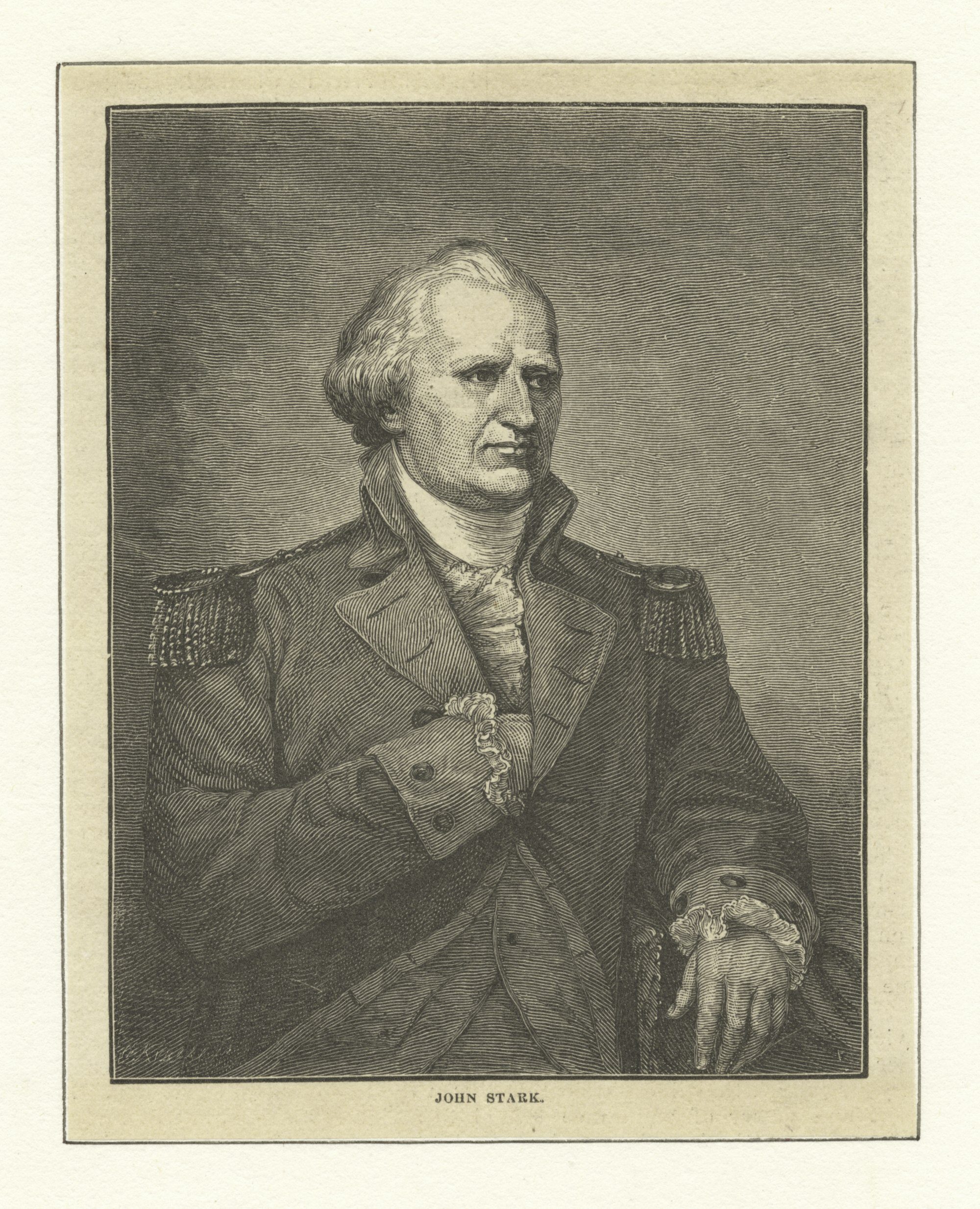
Image: An engraved archival print captures the stern, determined features of Major General John Stark. (Image via NYPL Digital Collections, public domain).