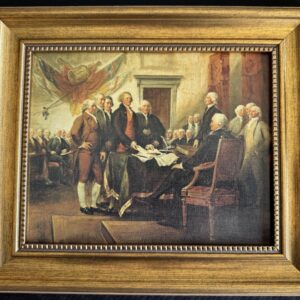

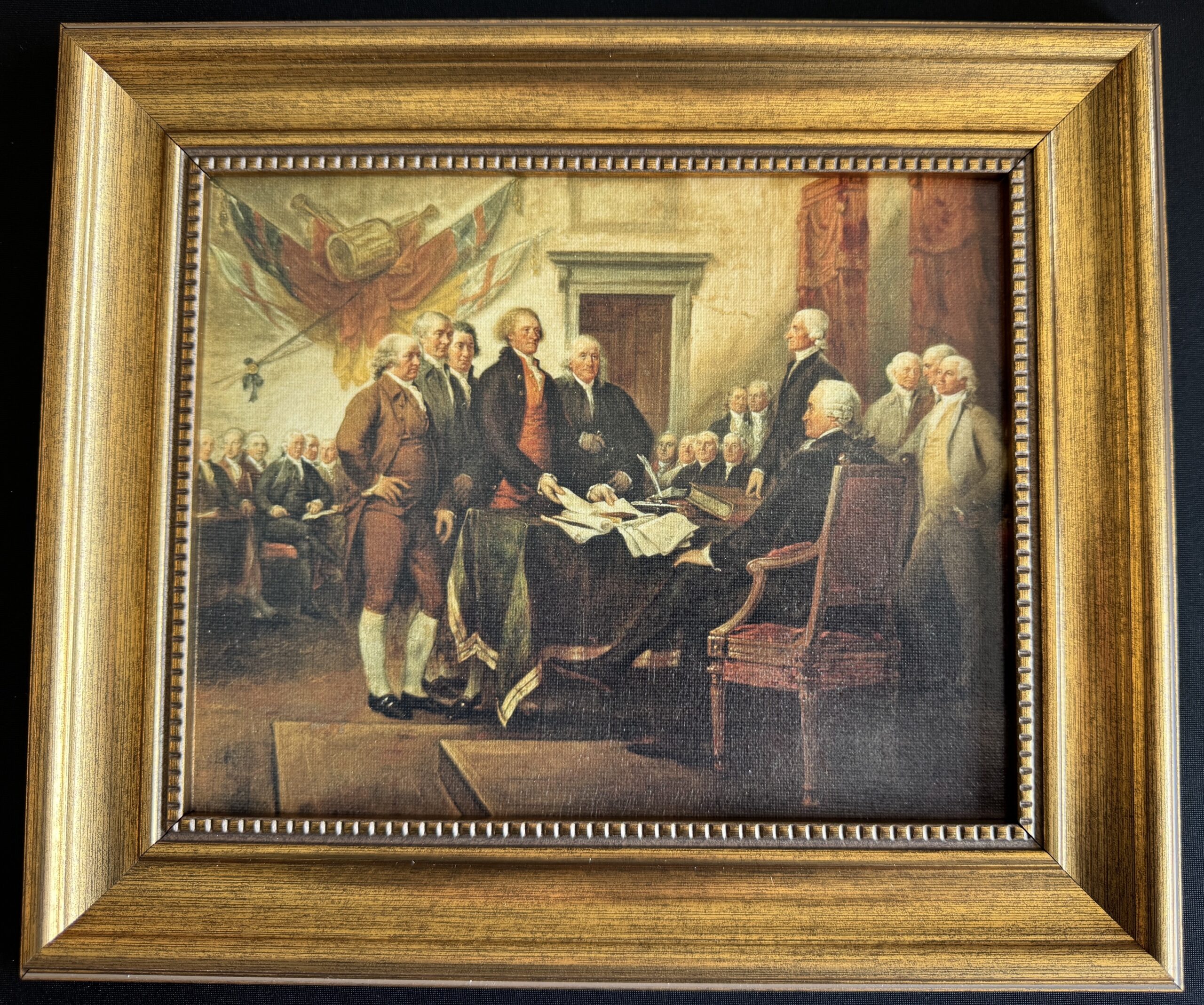
This exquisite reproduction of John Trumbull’s Declaration of Independence gains added presence within its elegant frame, but its power begins with the artist himself. Trumbull (1756–1843), often called the “Painter of the Revolution,” devoted much of his career to preserving the likenesses and deeds of the nation’s founders. Though he trained as a portraitist, his true ambition lay in creating large‑scale historical scenes that would fix the memory of the Revolution for future generations. His works—ranging from portraits of Alexander Hamilton to sweeping battlefield compositions—became some of the most widely recognized images of the early Republic.
The scene reproduced here is drawn from the composition Trumbull first conceived in the 1780s and refined over more than three decades. Rather than depicting the signing itself, Trumbull chose the moment of June 28, 1776, when the five‑man drafting committee—Jefferson, Adams, Franklin, Sherman, and Livingston—presented their proposed Declaration to the Continental Congress. He painted many of the delegates from life or from authoritative portraits, assembling forty‑seven figures to preserve their likenesses even though they had never all been in the room at the same time.
The monumental version of this painting, completed between 1817 and 1818, now hangs in the U.S. Capitol Rotunda. Trumbull based it on his earlier, smaller canvas (now at Yale), expanding the scale to twelve by eighteen feet and adjusting architectural details, furnishings, and drapery to heighten the drama and dignity of the scene. The Rotunda commission marked the culmination of his long effort to create a visual record of the Revolution—an effort that shaped how generations of Americans imagine the founding moment.
Set within its refined frame, this reproduction carries forward Trumbull’s original purpose: to preserve the faces, gestures, and civic ideals of the early Republic with clarity and reverence. It offers not just a decorative object, but a window into the artistic labor, historical imagination, and national memory that produced one of the most enduring images in American art.
Dimensions:
Overall Size w. Frame: 13 & 1/2″ Wide x 11 & 1/2″ High
Painting Size: 10″ Wide x 8″ High