
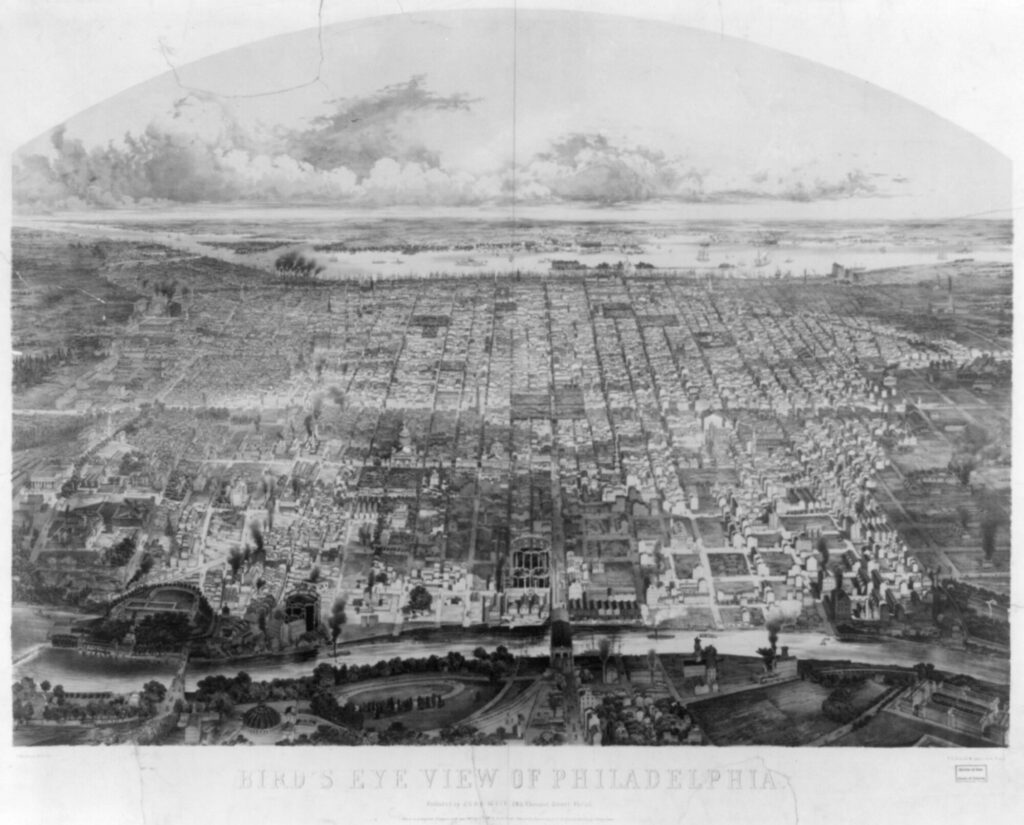
They came out of Kensington brickyards, Southwark boarding houses, river‑ward taverns, and the tight Catholic parishes that anchored Irish life in a city still scarred by the nativist riots of the 1840s. Philadelphia held one of the largest Irish populations in America by 1860, and when the war came, the city’s Irish answered in numbers that surprised even those who doubted them. Many gathered under the flags of the 116th Pennsylvania Infantry, Philadelphia’s contribution to the Irish Brigade—a regiment raised from neighborhoods where brogues still clung to the vowels and famine memories were only a decade old.
The 116th was a regiment of first‑generation Americans and recent arrivals, men who carried the burden of proving themselves. They marched with rosaries in their pockets and the hope that service might finally earn their community a measure of respect. Among them was Private William McCarter, a 21‑year‑old immigrant whose memoir would become one of the most vivid accounts left by any Union private. He wrote of Fredericksburg with the clarity of someone who had seen the world narrow to a stone wall, a winter sky, and the green flags of the Brigade lifting and falling in the smoke. His words preserved the cold, the hunger, the long march, and the strange mixture of fear and pride that defined the Irish ranks.
Others left no memoirs but left their names in the muster rolls—brothers like Alexander and Daniel Chisolm, who enlisted together and carried the same neighborhood stories into battle; laborers like Thomas Thorndell and John Wood, whose lives before the war were measured in shifts on the docks or days spent hauling coal along the Schuylkill. Their service was quieter, but no less binding. Families sent sons into the same companies, and when the regiment marched, it moved with the force of entire parishes behind it
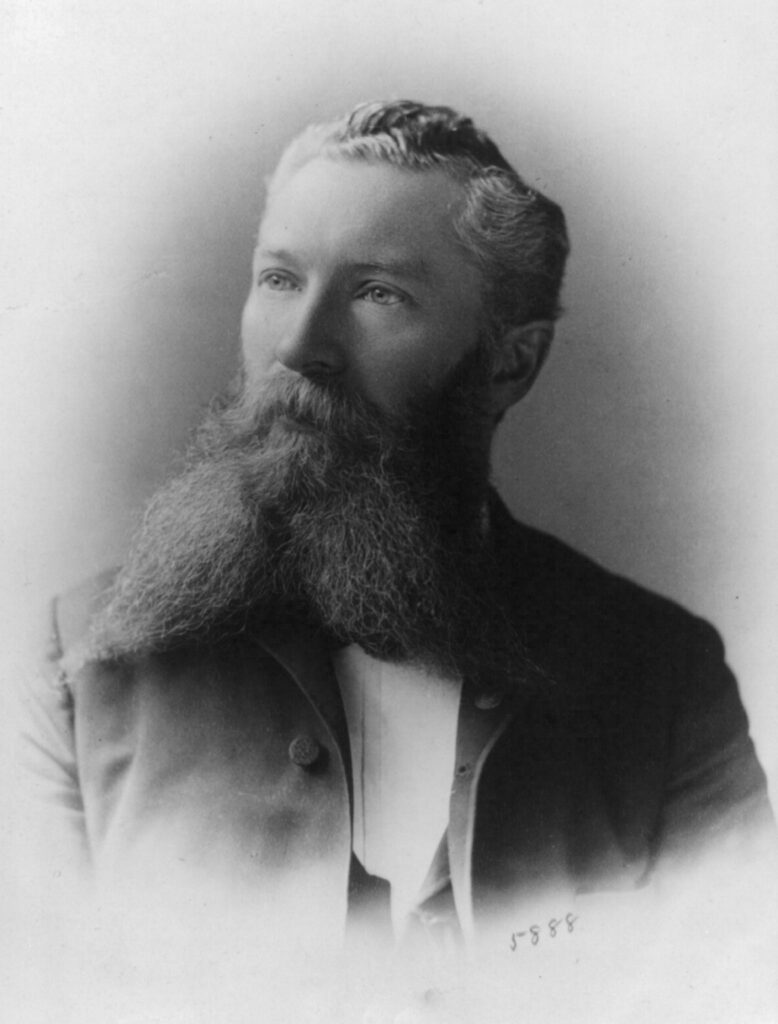
St. Clair Augustine Mulholland stood at the head of the 116th, an Irish immigrant who had come to Philadelphia as a boy and whose life seemed to mirror the hopes of the men he led. Commissioned as lieutenant colonel when the regiment joined Meagher’s Irish Brigade, he accepted a reduction in rank when the unit was briefly consolidated. He then fought his way back through sheer endurance—wounded at Fredericksburg, distinguished at Chancellorsville where he saved the guns of the 5th Maine Battery, and later struck down again in the Wilderness, at the Po River, and at Totopotomoy Creek. His gallantry earned him the Medal of Honor and, after the war, the brevet rank of major general. Mulholland carried the regiment through its hardest campaigns and later carried its memory, writing its history and becoming one of the most respected Irish Catholic laymen in Philadelphia. His story, like that of the men in his ranks, was one of belonging earned through service and sacrifice.
And then there were the Irvins of Company D—four brothers from the same Philadelphia household who stepped into the photographer’s studio in their new uniforms, the war still only a rumor. Their oval portraits, posed with the solemnity the era demanded, carry the story of Irish Philadelphia more clearly than any muster roll: four sons offering themselves together, believing that courage on the field might finally earn their people a place in a city that had not always welcomed them. Their faces—steady, unsmiling, almost ceremonial—stand as the quiet center of the regiment’s story, the moment where an immigrant community’s hopes and hardships resolve into the lives of real men preparing to march.
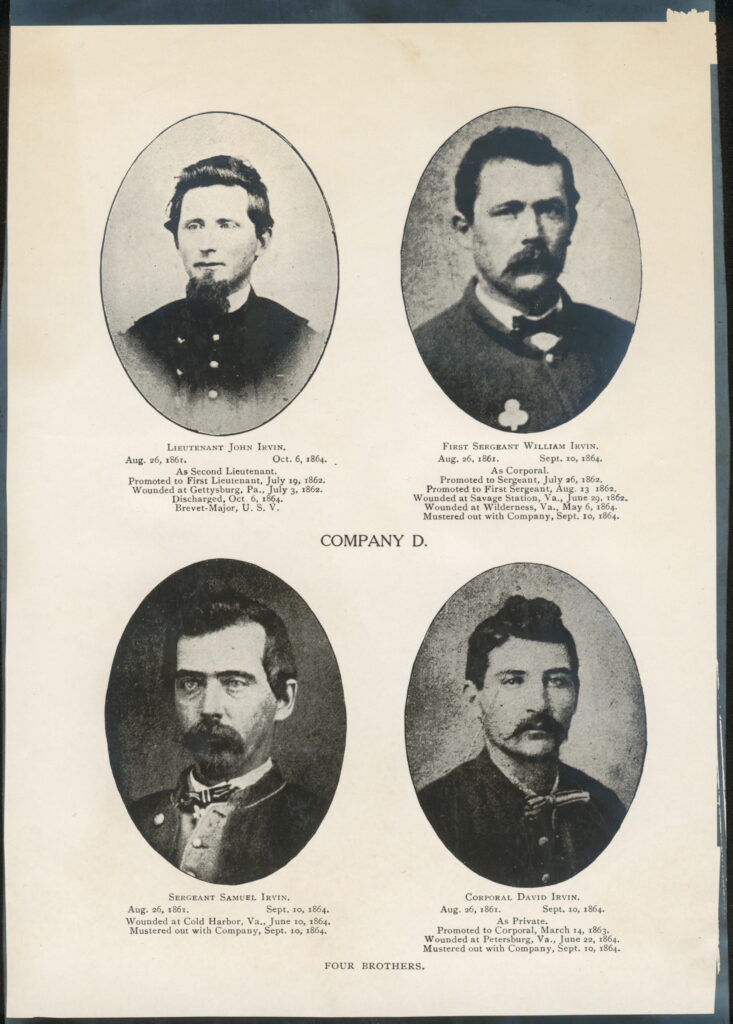
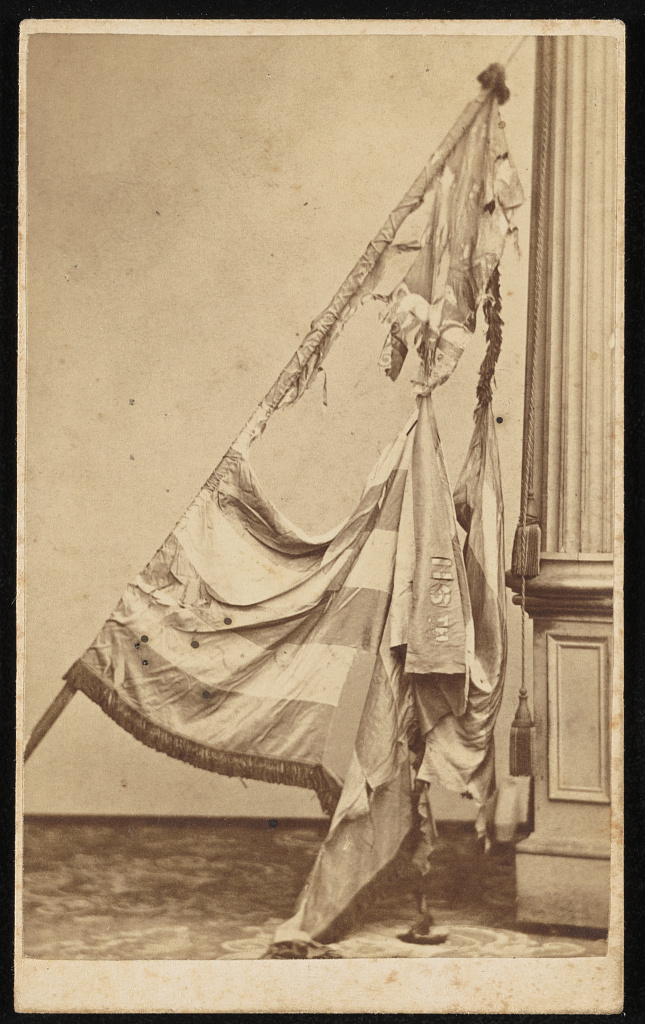
The 116th fought at Fredericksburg, where the Irish Brigade’s assault became a symbol of impossible courage; at Chancellorsville and Gettysburg; and through the grinding campaigns of 1864 and 1865, where the war became a test of endurance more than glory. Their casualties were heavy, their reputation fierce, and their presence in the Army of the Potomac slowly reshaped how Philadelphia saw its Irish community. The same city that had once burned Catholic churches now printed stories praising Irish valor. Service had not erased prejudice, but it had opened a space—one earned in blood and carried home in the battered green flags that returned to Philadelphia at war’s end.
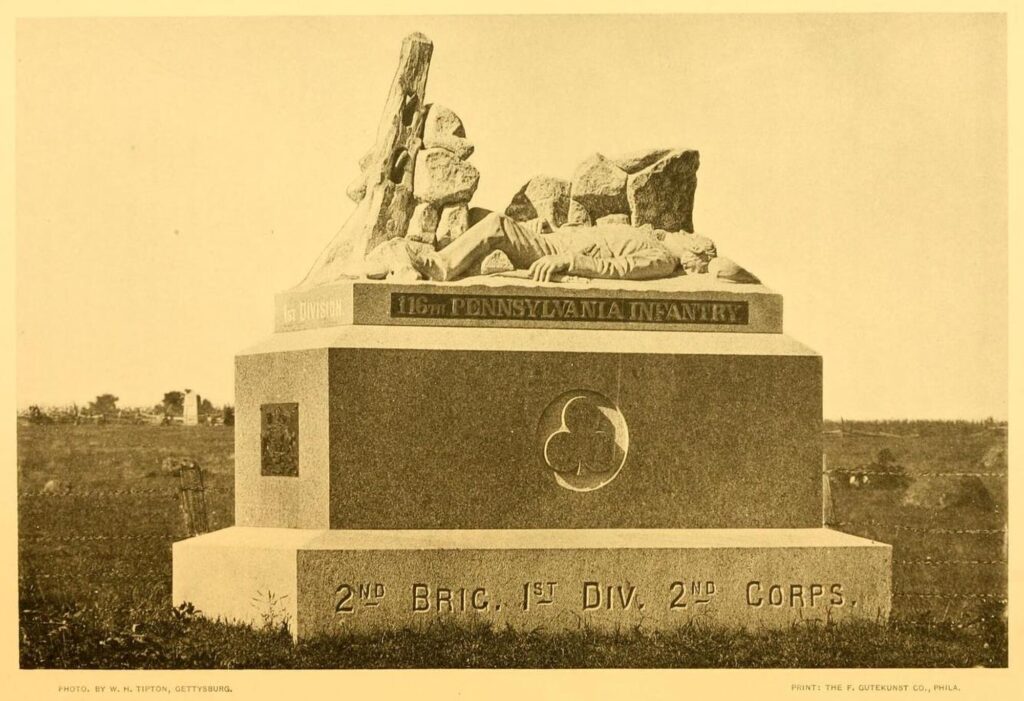
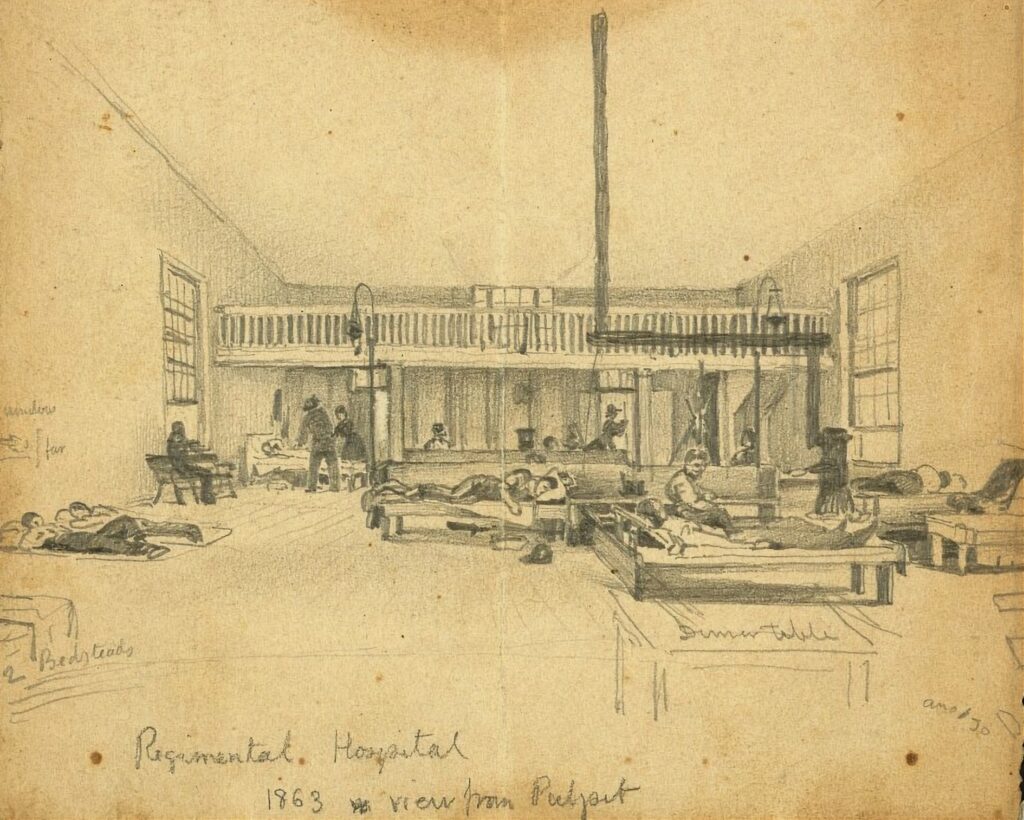
And somewhere in Philadelphia—often in a church hastily converted into a ward—men like the Irvins would return when the war finally touched their bodies. The city raised the regiment, and it received its wounded back again, rowhouses emptying into makeshift hospitals where pews became beds and surgeons worked beneath stained‑glass windows. A drawing from 1863 shows one of these regimental hospitals: long rows of cots, blankets pulled to chests, the pulpit still visible above the wounded. It is not marked as the 116th’s, but it might as well be. The same streets that sent four brothers into Company D would have carried them here after Savage Station, Gettysburg, Cold Harbor, Petersburg—each wound a reminder of how deeply the war reached into Philadelphia’s Irish homes.
When the survivors came back, they stepped into a city that would be shaped by their sons and grandsons—into police precincts, firehouses, political wards, and labor halls that bore the imprint of Irish service. Their story is not just one of battlefield heroism but of belonging: a people who fought for a nation still deciding whether it would claim them, and who, through their service, helped define what Philadelphia would become.


Leave a Reply