
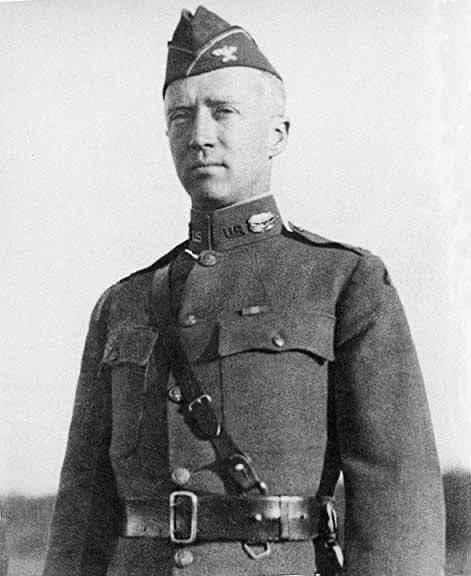
Born on November 11, 1885, in San Gabriel, California, George Smith Patton Jr. developed a military career that bridged the traditions of horse cavalry and the rise of armored warfare. He graduated from the United States Military Academy at West Point in 1909 and became an accomplished horseman and swordsman, representing the United States in the modern pentathlon at the 1912 Stockholm Olympics. His first combat experience came during the 1916 Punitive Expedition into Mexico, where his participation in a motorized raid offered an early connection between his cavalry training and the mobility that would define his later commands.
During World War I, Patton helped develop the American Army’s emerging tank force, organizing training in France and commanding a tank brigade in combat. He led tanks during the Saint-Mihiel offensive in September 1918 and was wounded later that month during the Meuse-Argonne offensive. These experiences established his commitment to leading from the front and exploiting the offensive potential of armored vehicles.
World War II brought Patton his most consequential commands. He led II Corps in Tunisia, the Seventh Army during the invasion of Sicily, and the Third Army in northwestern Europe. His reputation rested on aggressive offensive operations, rapid movement, and a determination to maintain pressure on retreating enemy forces. During the Battle of the Bulge in December 1944, the Third Army’s turn north to relieve the surrounded American forces at Bastogne became one of the best-known achievements of his command.
Patton’s career spanned a defining transition in military history, from the traditions of horse cavalry to the demands of mechanized warfare. His early experience as a cavalry officer and World War I tank commander provided the foundation for his later leadership of fast-moving armies. His World War II campaigns secured his place among the most recognizable American commanders of the conflict.
