
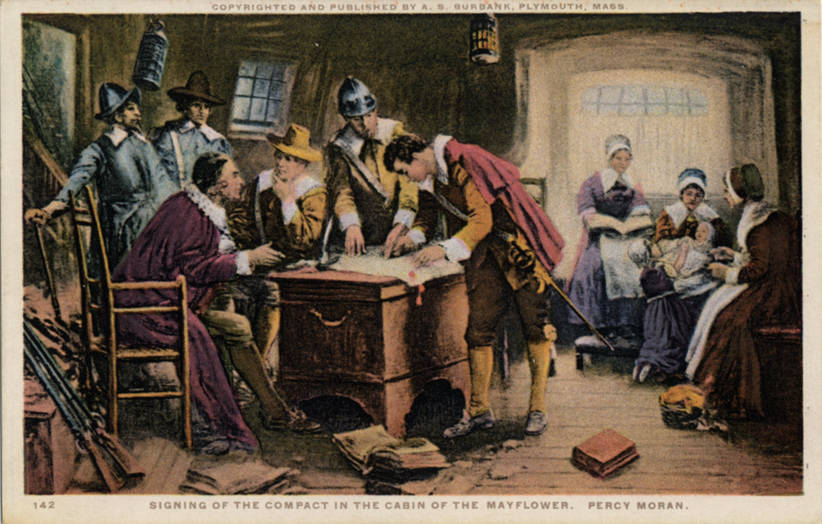
On November 11, 1620, under the Julian calendar then used by the English—November 21 in the Gregorian calendar used today—forty-one male passengers aboard the English merchant ship Mayflower signed a brief political covenant while anchored at Cape Cod. They had intended to settle near the mouth of the Hudson River, within the territory covered by their existing patent, but dangerous shoals and poor winds frustrated their attempt to sail south. Remaining in New England placed them outside the territory where they had permission to settle, raising doubts about the authority of the colony’s leaders. To maintain order and establish a shared basis for civil government, the passengers adopted the agreement now known as the Mayflower Compact.
The signers covenanted to combine themselves into a “civil Body Politick,” promising obedience to the “just and equal Laws, Ordinances, Acts, Constitutions and Offices” established for the colony’s general good. Their agreement did not reject monarchy: it expressly affirmed their allegiance to King James I. Nor did it establish democracy in the modern sense. Women did not sign, although some servants did. Its distinctive contribution was a mutual pledge to create and obey a civil government, grounding local political authority in an agreement among the signers while preserving their obligations as English subjects.
The Compact’s enduring significance lies in its place within the developing American tradition of self-government. It was not a detailed constitution or a declaration of independence, but a practical covenant through which settlers committed themselves to political order and the common good. More than a century and a half before the United States Constitution, it offered an important precedent for government established through collective agreement—without extending that consent to everyone who would live under its authority. Percy Moran’s later painting imagines the solemn atmosphere of the cabin signing, giving visual form to a moment when a vulnerable community bound itself to a shared political undertaking.
