
On November 7, 1805, along the northern shore of the Columbia River in present-day Washington, William Clark believed the Corps of Discovery had finally reached the Pacific Ocean. After nearly eighteen months of river travel, mountain crossings, and periods of severe hunger, the expedition looked west across a broad expanse of water toward what appeared to be its destination. “Great joy in camp,” Clark recorded in his journal. Yet the water before them was the Columbia estuary, and the open Pacific remained roughly twenty miles away. His celebration captured a moment of genuine relief founded on a mistaken identification.
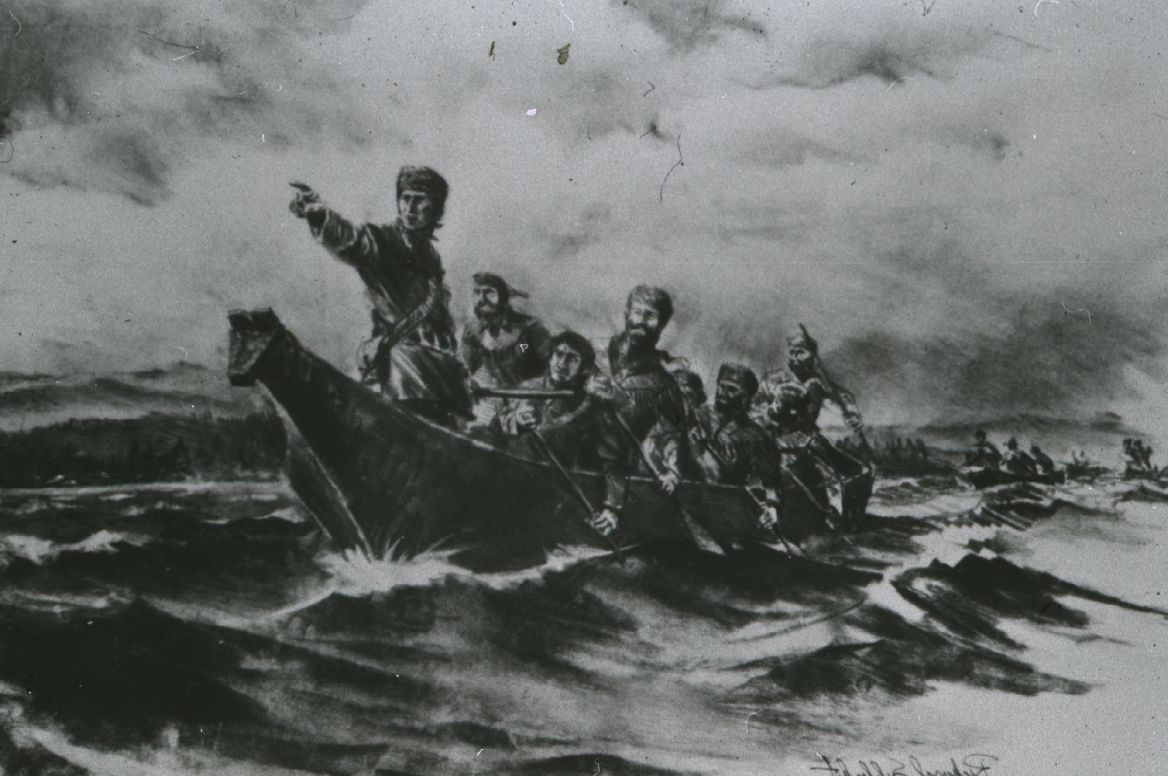
The apparent arrival did not end their difficulties. Over the following days, strong winds, heavy rain, and rough water repeatedly obstructed the expedition’s progress along the estuary’s northern shoreline. Narrow stretches of shore offered uncomfortable camps, while waves threatened the dugout canoes on which the travelers depended. The party advanced when conditions allowed, enduring wet bedding, damaged provisions, and uncertainty about when it could continue. By November 15, Clark and the main party had gained an actual view of the Pacific near Chinook Point. What had seemed an immediate triumph on November 7 became a prolonged struggle to complete the final approach.
The enduring significance of Clark’s entry lies in the contrast between geographical error and emotional truth. The ocean was not yet visible, but his words expressed the anticipation of an expedition nearing its western destination. That achievement, however, did not mark the discovery of an unknown or empty coast. The travelers were entering an inhabited region with established communities and trading connections; Clark’s November 7 account itself records encounters with Indigenous residents, including people who spoke some English. Read in that setting, his declaration preserves something more revealing than a simple moment of conquest: the joy of exhausted travelers approaching a long-sought destination, still dependent on weather, local knowledge, and a world that existed long before their arrival.
