
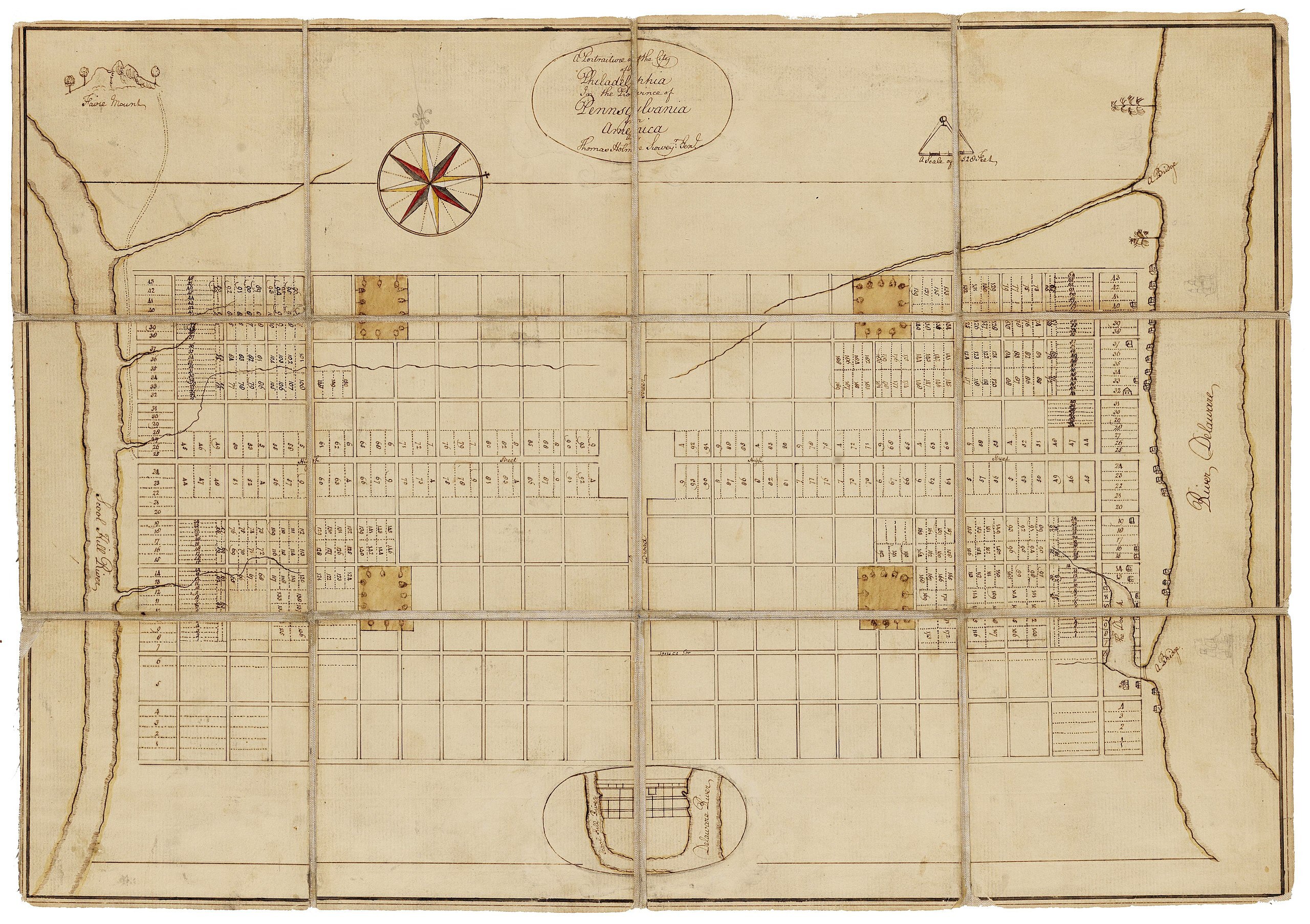
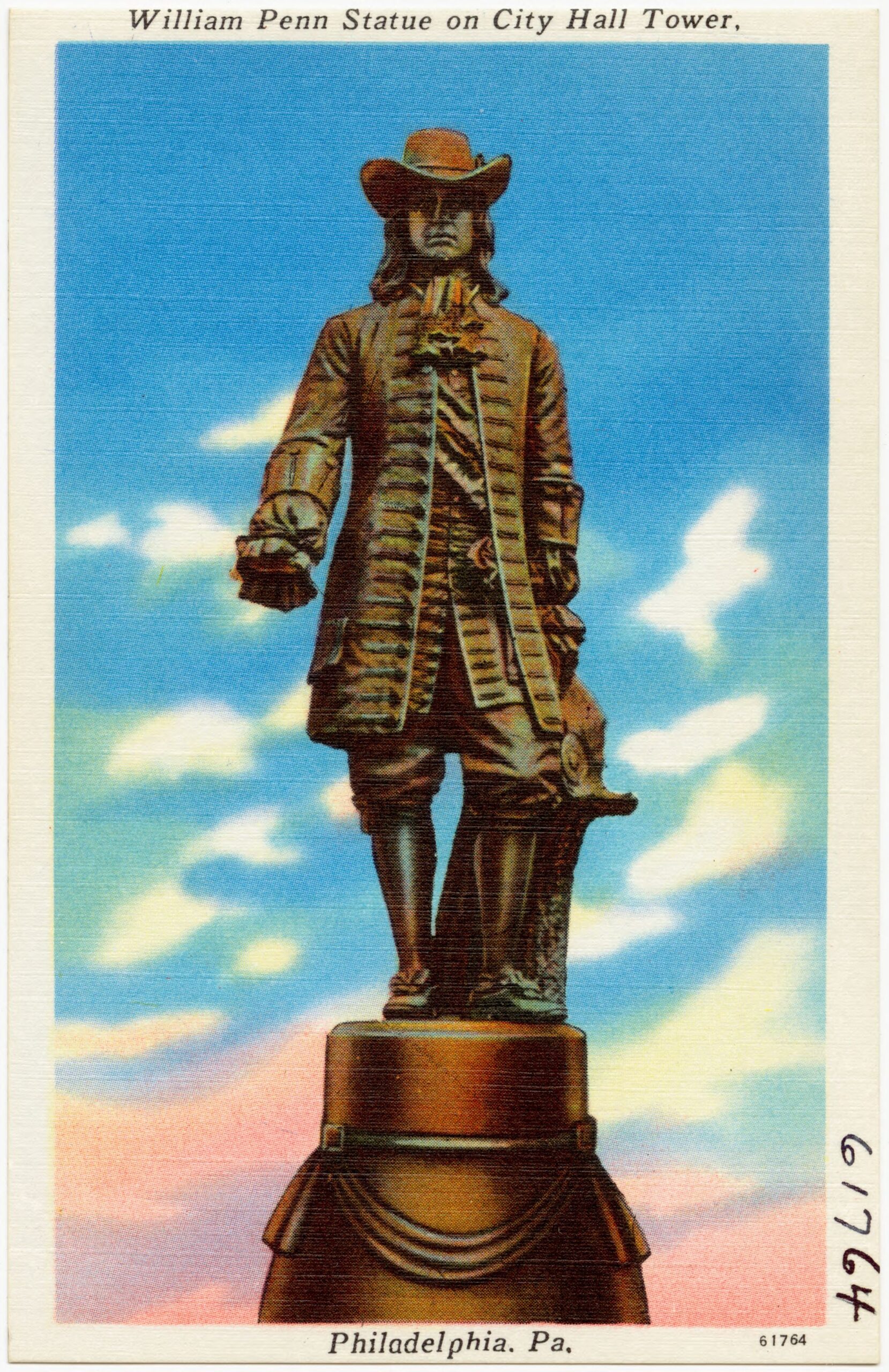
In 1682, Quaker leader William Penn founded Philadelphia as the principal city of his new colony—a settlement intended to reflect his ideals of religious freedom and orderly community life. October 27 is commonly cited as its founding date, although it more precisely marks Penn’s arrival at New Castle, in present-day Delaware. By the time he reached Philadelphia, his surveyor-general, Thomas Holme, was already laying out its streets.
Working under Penn’s direction, Holme developed a rectangular street grid stretching between the Delaware and Schuylkill Rivers. The planned city covered approximately 1,200 acres, generally within today’s Vine and South Streets. Published in London in 1683 as A Portraiture of the City of Philadelphia, the plan presented an orderly alternative to the crowded, irregular streets familiar in older European cities. Two principal thoroughfares—Broad Street and High Street, now Market Street—were designed to be 100 feet wide. A central civic square and four neighborhood squares provided space within the grid for public life and greenery.
The design was more than an exercise in geometry. Influenced by London’s devastating plague and fire in the 1660s, Penn envisioned a “green country town” where houses could stand amid gardens and orchards rather than crowd together. Open space and separation between buildings were intended to reduce the spread of fire and create a healthier environment. His ambition was a city that would “never be burnt, and always be wholesome”—an aspiration that shaped Philadelphia’s enduring street plan, even though no urban design could guarantee either outcome.
