
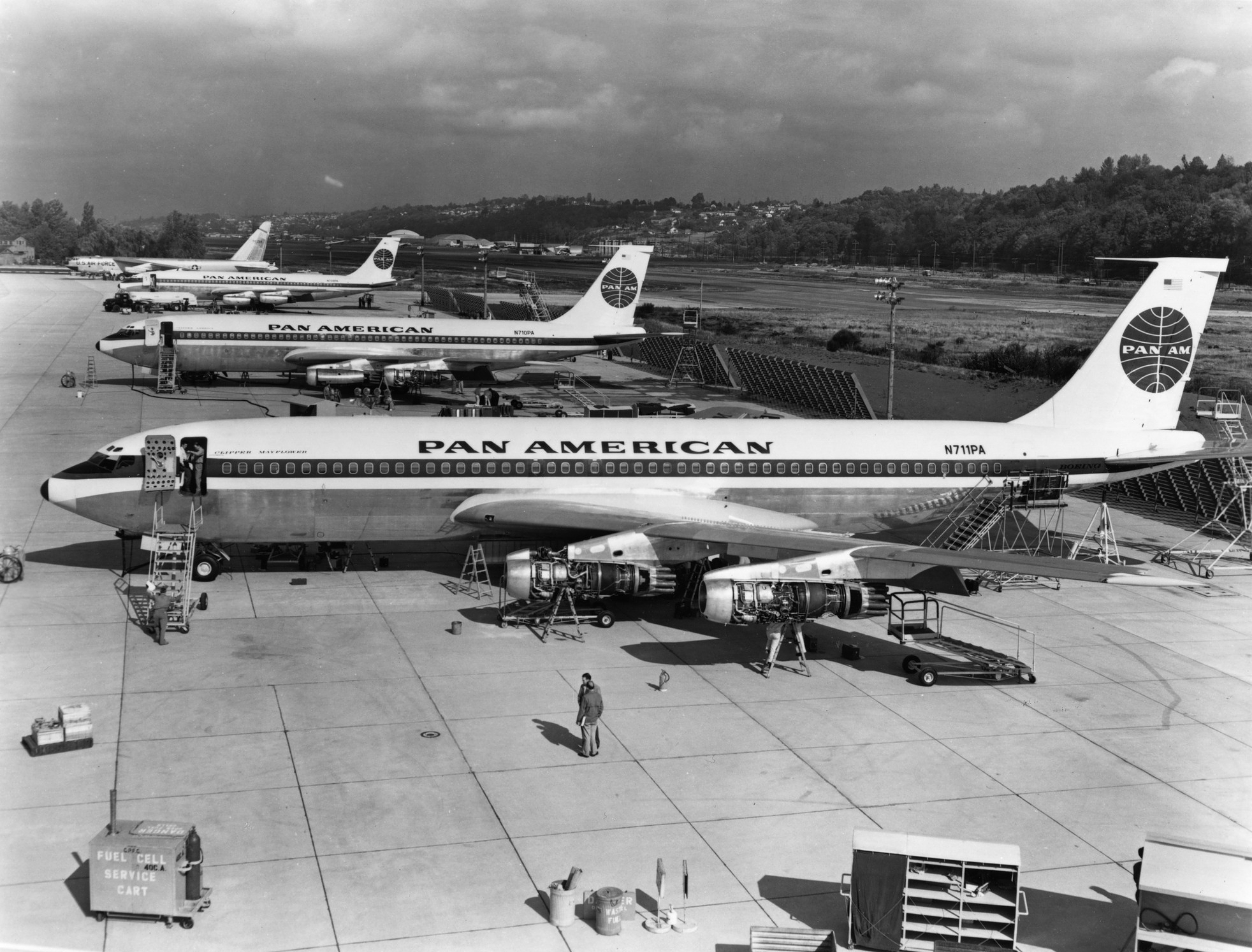
On October 26, 1958, Pan American World Airways inaugurated scheduled Boeing 707 passenger service with a flight from New York’s Idlewild Airport to Paris–Le Bourget. The aircraft, named Clipper America, carried 111 passengers and stopped at Gander, Newfoundland, to refuel. The journey took 8 hours and 41 minutes, including the stop, with approximately seven hours spent in the air.
Pan Am was not the first airline to offer scheduled transatlantic jet service. BOAC had launched its de Havilland Comet 4 service between London and New York 22 days earlier, on October 4. Pan Am’s distinction was bringing the American-built Boeing 707 into scheduled commercial service—a milestone in the expansion of jet-powered passenger travel.
The new aircraft helped make the Atlantic feel smaller by reducing the time required to cross it. Jets offered a substantial improvement over piston-engine airliners, and the larger, faster 707 soon became a formidable competitor to the Comet. For passengers and airlines alike, the significance extended beyond a celebrated inaugural departure: jet travel was becoming a scheduled commercial service rather than a technological promise.
Clipper America’s flight is best understood not as the single event that created modern global travel, but as a defining milestone in that transformation. Its historical importance rests on something concrete: the Boeing 707 had begun carrying paying passengers across the Atlantic on a regular airline route.
