
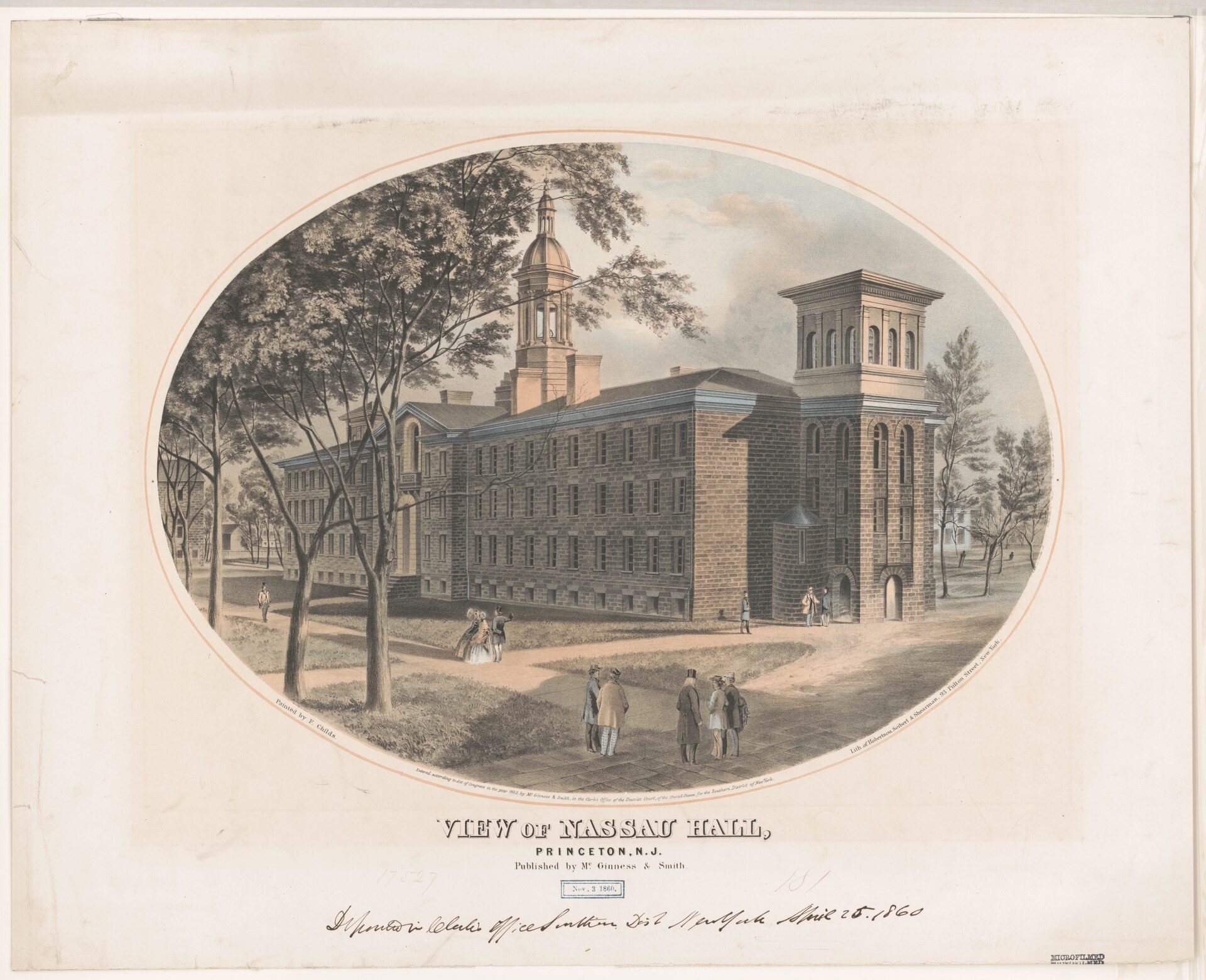
On October 22, 1746, John Hamilton, acting governor of New Jersey, granted the charter establishing the College of New Jersey, the institution now known as Princeton University. Founded by Presbyterian ministers and lay supporters, the college began instruction in Elizabeth in May 1747 before moving to Newark later that year. In 1756, it settled permanently in Princeton, where the newly constructed Nassau Hall—the largest stone building in the American colonies—housed the growing college. The institution adopted the name Princeton University in 1896.
One of the charter’s most notable provisions concerned religious liberty. Although the college’s founders were Presbyterians, the charter stipulated that students should not be excluded from its educational opportunities because their religious affiliation differed from that of the trustees. This provision gave religious openness a place in the institution’s founding principles, although it should not be mistaken for a modern guarantee of universal inclusion. In 1748, Governor Jonathan Belcher issued a replacement charter after Hamilton’s authority to grant the original had been challenged.
The college later became directly entangled in the struggle for American independence. On January 3, 1777, fighting during the Battle of Princeton reached Nassau Hall as George Washington’s forces defeated British troops. In 1783, the building served another national purpose, housing the Continental Congress from June to November. While meeting in Princeton, Congress learned that the Treaty of Paris had been signed, formally recognizing American independence.
The anniversary of the 1746 charter marks the beginning of an institution whose early history connects colonial education, religious liberty, and the founding of the United States. From its first classes in Elizabeth to its permanent home in Princeton, the college developed alongside the nation it would help shape.
Image: Nassau Hall c. 1860. An archival print depicts Nassau Hall at the College of New Jersey, now Princeton University. Completed in 1756, the building became a site of fighting during the Battle of Princeton in 1777 and housed the Continental Congress in 1783. The college adopted its present name in 1896.
