
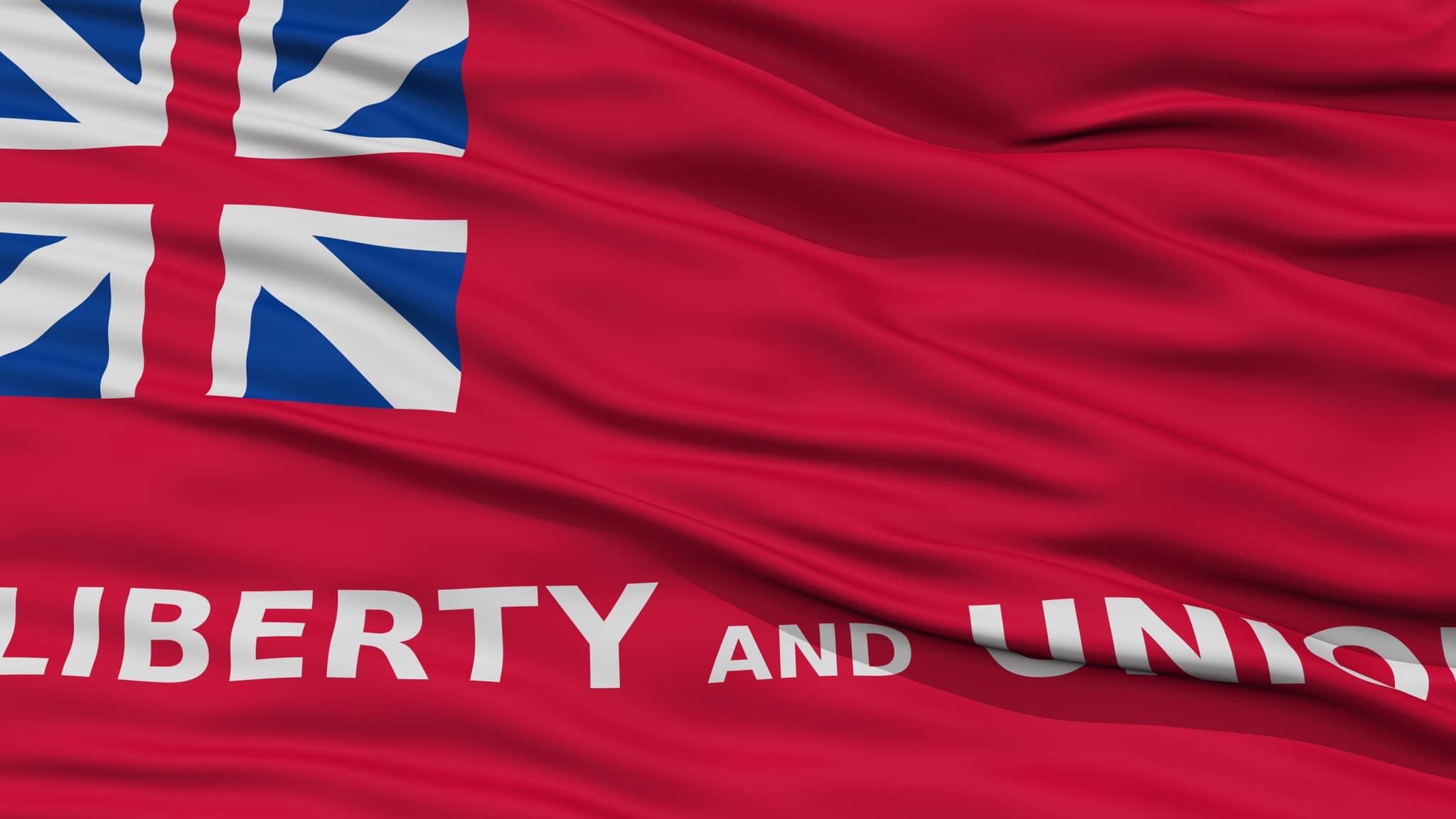
On October 21, 1774, patriots in Taunton, Massachusetts, raised a towering liberty pole and flew a flag bearing the words “LIBERTY AND UNION.” The Boston Evening-Post reported the event three days later, describing a pole 112 feet long and a “Union flag” with the words sewn onto it. It was a striking public declaration of resistance to British policies.
The flag is traditionally depicted as a British Red Ensign, retaining the British Union flag in the upper-left corner and adding “LIBERTY AND UNION” to the red field. Its original appearance is not known with certainty, however; the familiar design is based on a limited contemporary description. Its combination of British imagery and a defiant motto reflects the complicated politics of resistance before independence.
The declaration attached to the pole made the protesters’ position explicit. Identifying themselves as the “Sons of Liberty in Taunton,” they defended their rights as “American Englishmen” and condemned the actions of Parliament and the British ministry. They pledged to preserve their “birthrights and charter rights” and to “resist even unto blood” attempts to diminish them. Their language expressed a willingness to fight for their liberties without yet declaring a separate American nation.
Today, Taunton commemorates the raising through its Liberty and Union celebrations. The flag remains a distinctive reminder of the movement toward revolution: a community asserting its rights, publicizing its resistance, and expressing that resistance through a banner that still retained British symbolism.
Photo Caption:
The Taunton Flag — Liberty and Union
A representation of the flag raised by Taunton patriots on October 21, 1774. Traditionally shown as a British Red Ensign bearing the words “LIBERTY AND UNION,” the flag expressed resistance to British policies before American independence. Its precise original appearance remains uncertain.
