
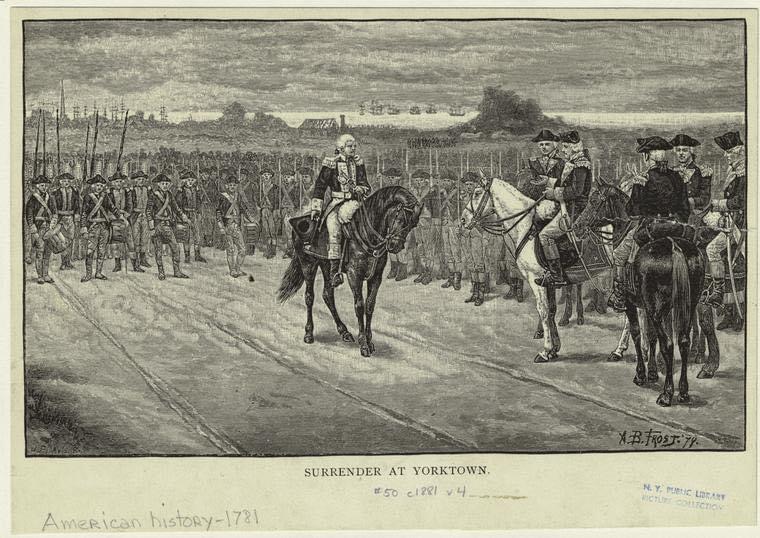
On October 19, 1781, the British army under Lord Cornwallis marched out of Yorktown, Virginia, to surrender to the allied American and French forces commanded by General George Washington and the Comte de Rochambeau. Encircled on land and cut off by sea, Cornwallis had seen his final attempt to evacuate across the York River to Gloucester Point thwarted by a storm. On October 17, he requested a suspension of hostilities to negotiate surrender. Two days later, his army laid down its arms in one of the decisive moments of the American Revolution.
Washington designated Major General Benjamin Lincoln to receive the British submission—a striking reversal for the officer who had surrendered Charleston to the British the previous year. The allied troops formed two facing lines extending more than a mile, the French in complete uniforms and the Americans less uniformly dressed but visibly proud. Between them marched the British, with colors cased and drums beating a British march. Thacher recorded that some soldiers threw their weapons onto the pile with such violence that they appeared determined to make them useless, until Lincoln checked the disorder.
Cornwallis did not attend the ceremony, reporting illness and sending Brigadier General Charles O’Hara in his place. The victory reflected the strength of the Franco-American alliance: Lafayette’s forces had helped contain Cornwallis in Virginia, Washington and Rochambeau had brought their armies south, and the French fleet under Admiral de Grasse had closed the route by sea. Yorktown did not immediately end the war, but it helped turn British politics toward peace. American independence received formal British recognition in the Treaty of Paris in September 1783.
