
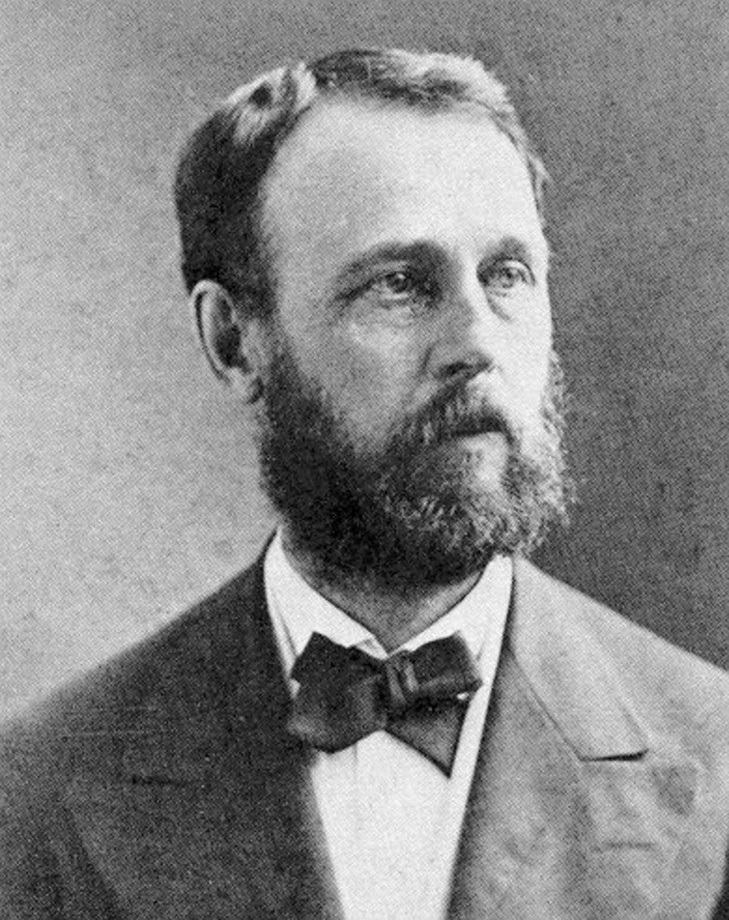
Renowned American astronomer Asaph Hall was born on October 15, 1829, in Goshen, Connecticut. Working at the U.S. Naval Observatory during a period of rapid advances in telescope design, Hall secured his place in the history of science through meticulous observation and precise orbital calculations. His command of celestial mechanics allowed him to track the motions of distant worlds with exceptional accuracy for his time.
Hall achieved international acclaim when he discovered Phobos and Deimos, the two small moons of Mars, during the planet’s especially close opposition in August 1877. Using the observatory’s great 26-inch Clark refractor, he pushed the instrument to its limits to make his first confirmed sighting of Deimos on August 12, followed by Phobos on August 18. For generations, astronomers had speculated about whether the Red Planet possessed natural satellites, and Hall’s painstaking discovery decisively confirmed that it did by locating the faint, fast-moving bodies that had eluded earlier observers.
The discovery reshaped contemporary understanding of Mars and its place in the solar system, earning Hall prestigious honors from scientific institutions in Europe and North America. In recognition of his contributions to planetary science, craters on both Earth’s Moon and Phobos are named in his honor today. This portrait preserves the likeness of a dedicated researcher who spent his life charting the heavens and expanding humanity’s view of the cosmos.
